


Go back to Blog


Jennifer Edidiong
Marketing
8 min read
Share to
Database Lookup vs Document Verification: Which Should You Choose

When a new user signs up, should the identity check start with a government database or a photo of their ID? It depends on what you need to confirm.
Database lookup checks identity details against an official record, while document verification examines the document itself. They work differently, suit different situations, and have different failure points.
This guide breaks down where each method works best, what each one misses, and when using both together makes sense.
What Database Lookup Is
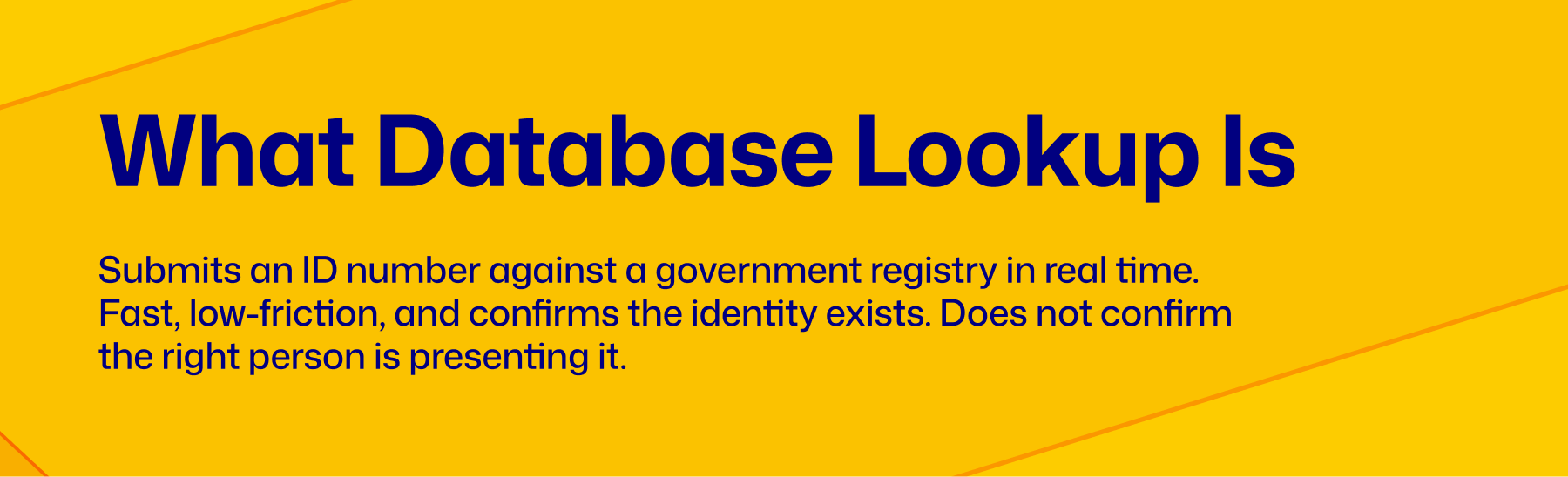
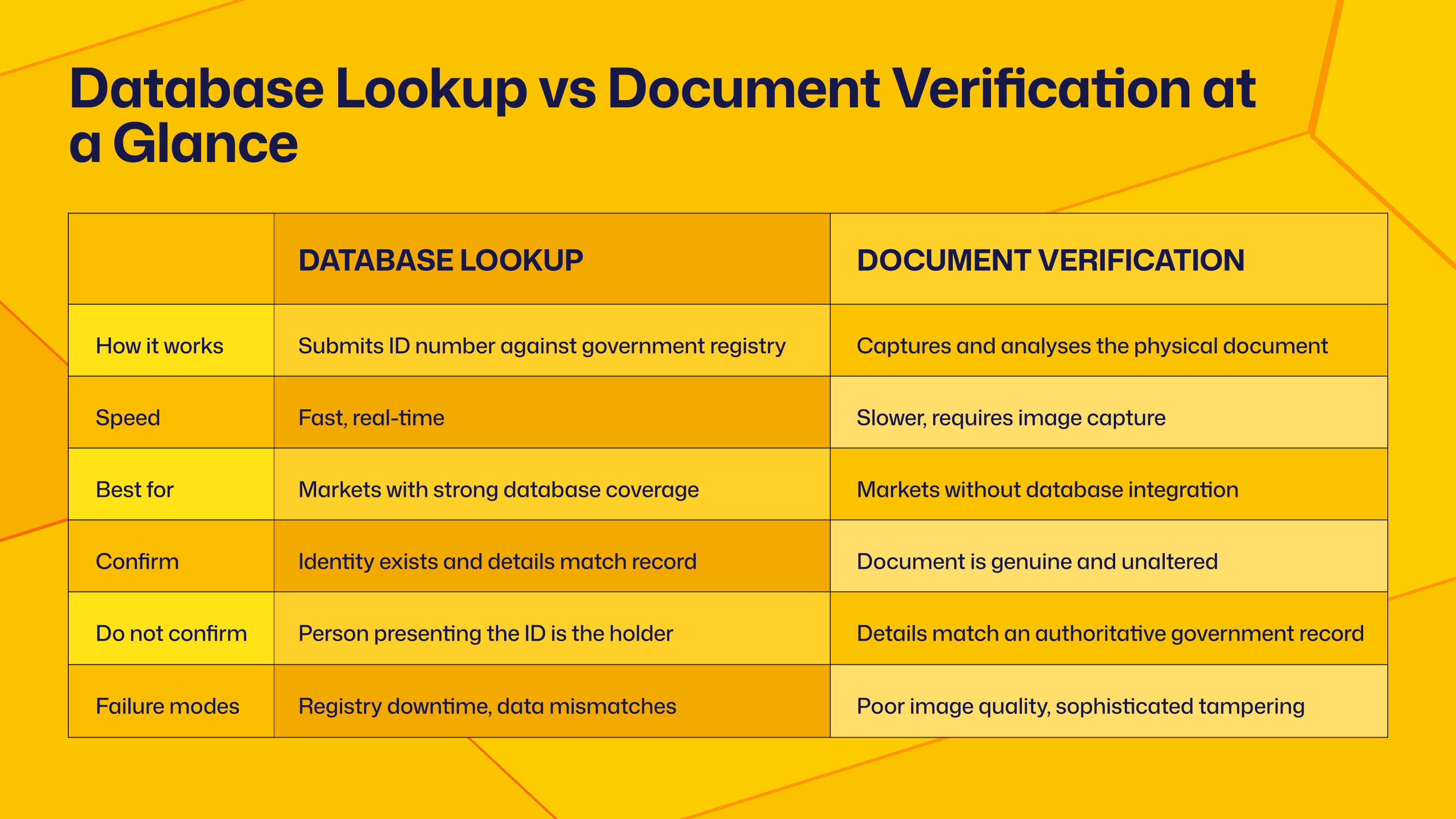
Database lookup checks an ID number against a government registry in real time. It tells you whether the identity is valid and whether the submitted details match the official record.
Database lookup answers three practical questions:
- What it checks: The lookup matches the ID number, name, date of birth, and, where available, address against the government record. In Nigeria, this includes BVN or NIN; in Ghana, the Ghana Card; and in Kenya, the national ID.
- What it returns: Depending on the database and integration, you can get a match result, confidence score, and government-record photo for face matching. The process is fast and creates little friction because users submit an ID number instead of capturing a document.
- What it cannot tell you: A database match confirms that the identity exists and the details match the official record. It does not confirm that the person submitting the ID is the rightful holder. Face matching and liveness help close that gap by checking the person presenting the identity.
Database lookup works best when you can access a reliable government database, and your users have valid, registered ID numbers.
What Document Verification Is
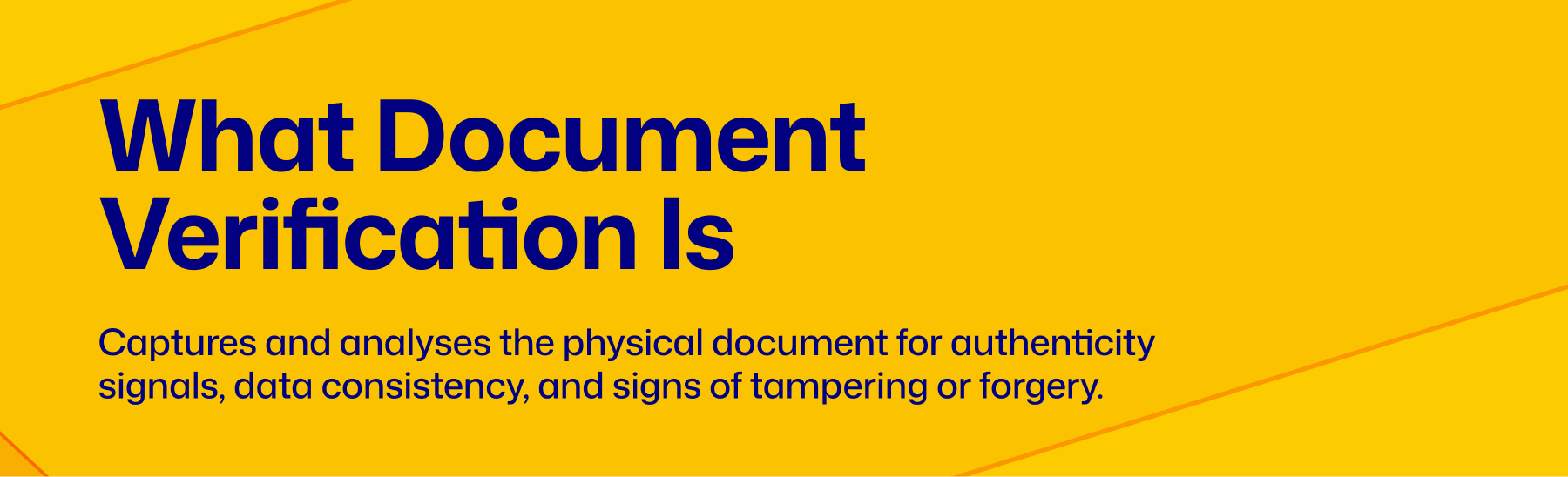
Document verification captures an image of an identity document and analyses it for authenticity, data consistency, and signs of tampering or forgery.
Document verification focuses on three practical questions:
- What it checks: OCR extracts information from the document, while authenticity checks examine features such as fonts, layout, and document structure. These checks help determine whether the document is genuine and whether it has been altered.
- What it returns: The process can return a pass or fail result, extracted identity data, and a confidence score. It takes longer than a database lookup because the user needs to capture and submit an image of the document.
- What it cannot tell you: A document can appear genuine without proving that its details match a current government record. Document verification checks the document itself, while a database lookup checks the identity details against an authoritative government source.
Document verification is useful when a live database check is not available or when you need to confirm that the document itself is genuine.
Where Each One Works Best
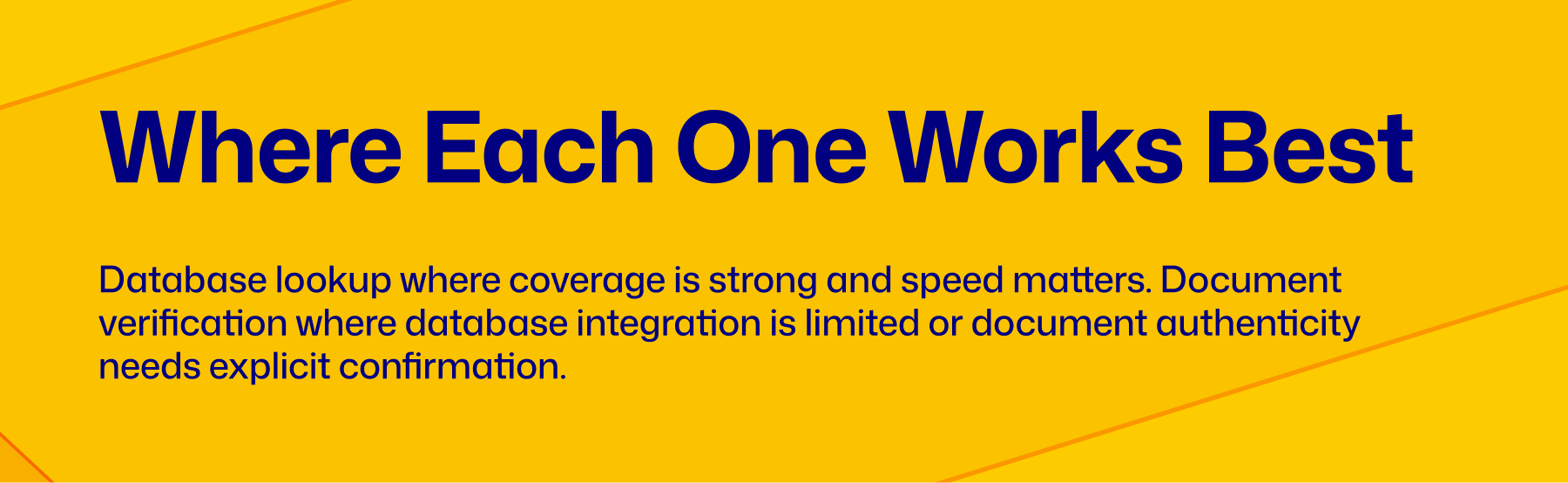
The right choice depends on the market, the user base, and what the verification needs to confirm.
Database lookup works best when:
- Government database coverage is reliable: It works well when the relevant identity database is accessible and supports the required checks. For example, platforms in Nigeria can use BVN or NIN, while those in Ghana can verify against the Ghana Card.
- Speed matters: Database lookup verifies identity details without requiring users to capture a document. This makes it useful for high-volume onboarding where low friction matters.
Document verification works best when:
- Database access is limited: A market or document type may not have accessible database connectivity. In that case, document verification provides another way to verify the identity document.
- Document authenticity matters: Some use cases require more than matching identity details against a record. Document verification checks the document for signs of tampering and other authenticity signals.
Neither method covers every verification gap. Understanding where each one fails is just as important as knowing where it works.
The Failure Modes

Knowing where each method breaks is as important as knowing where it works.
Database lookup fails when:
- The government registry is unavailable: Downtime or latency can prevent a lookup from returning a result. A defined fallback keeps the verification process moving instead of treating the failed request as a failed verification
- The ID cannot be matched: An incorrect or unregistered ID may return no match. That does not automatically mean fraud, so the user needs another verification path.
- The details do not match: Differences between submitted information and the government record can prevent a match. Errors or outdated information in the underlying record can also contribute to these mismatches.
Document verification fails when:
- The image quality is poor: Blurry images, glare, poor lighting, or low resolution can make it difficult to extract and assess document details.
- Tampering is difficult to detect: Sophisticated alterations may not show obvious signs during document analysis. Additional verification signals may be needed to identify the risk.
Both methods have failure points. A strong verification flow accounts for them instead of relying on one method for every user.
Why Many Platforms Use Both Together
Database lookup and document verification work better together because each closes gaps the other leaves open.
Here is how to combine both:
- Use database lookup first: Where reliable government database coverage exists, it can verify identity details quickly with minimal friction. Most users can complete the check without submitting a document.
- Use document verification as a fallback: A lookup can time out or return no match even when there is no confirmed fraud. Document verification provides another path when the database check cannot produce a usable result.
- Add document verification for higher-risk cases: Some products or user segments may require stronger checks. Combining a database match with document verification can confirm both the identity record and the document itself.
This is exactly how Dojah's verification infrastructure is built to work.
How Dojah Supports Both Methods
Dojah supports database lookup across multiple African ID systems and document verification as a fallback or additional layer. Platforms can match the verification approach to their market, user base, and risk profile without managing separate vendors.
Here’s how each method fits into the verification process:
- Database lookup across African markets: Dojah supports BVN and NIN in Nigeria, the Ghana Card in Ghana, national ID in Kenya, South African ID, and other African markets through one integration. Results are returned in real time, with fallback handling for timeout scenarios.
- Document verification as a fallback or additional layer: When database connectivity is limited or document authenticity needs to be confirmed, document analysis runs in the same flow. A separate verification tool or vendor is not required.
- Both methods in one configurable flow: Teams can configure which check runs first, when the fallback triggers, and which users go through both layers from the dashboard. Changes do not require an engineering update each time.
For African platforms, Dojah brings both methods into one integration, making it easier to choose the right approach for each use case.
See how Dojah's database lookup and document verification work. Explore the docs or book a demo.
Frequently Asked Questions About Database Lookup vs Document Verification: Which Should You Choose
1. What is the difference between database lookup and document verification?
Database lookup checks submitted identity details against an official government record, while document verification checks the identity document itself for authenticity and signs of tampering.
2. Which is better for KYC verification in Africa?
Neither method is universally better. The right choice depends on the market, available government database coverage, user journey, and level of risk. In some cases, using both methods provides stronger verification.
3. When should a fintech use government database lookup vs document verification?
Government database lookup works well when reliable government identity data is accessible and fast verification is important. Document verification is useful when database access is limited or when the authenticity of the document itself needs to be confirmed.
4. Can database lookup and document verification be used together?
Yes. A fintech can use database lookup as the primary check, then use document verification as a fallback when the lookup fails or as an additional check for higher-risk users.
5. What happens when a database lookup returns no match?
A no-match result does not automatically mean the user is fraudulent. The ID may be incorrect, unregistered, or the submitted details may not match the government record. A fallback verification method or manual review can provide another path.
6. What should fintechs consider when choosing a KYC verification method?
Consider the identity systems available in each target market, verification speed, user friction, document coverage, failure handling, and the level of assurance required for the use case. A flexible setup can combine multiple verification methods when necessary.
Start using Dojah for all your business needs


