


Go back to Blog


Jennifer Edidiong
Marketing
9 min read
Share to
Dojah V. Seamfix: Which KYC API Should You Choose?
As a founder, fraud, or product lead, you’ve likely faced the challenge of verifying user identities and managing risk across your platform. Choosing the right KYC API is essential for onboarding users securely while staying compliant with regional and global regulations.
Dojah and Seamfix are two top identity verification providers in Africa, each taking a different approach to KYC and fraud management. In this guide, we break down what each platform offers, compare their key features, and help you understand which solution fits your business needs.
Whether you’re exploring Seamfix alternatives or specifically comparing Dojah vs Seamfix KYC API solutions, this guide gives you the clarity to make an informed decision.
Here’s what we’ll cover:
- Overview and Key features of each platform
- Pros and cons based on real use cases
- Verdict on which platform best supports identity verification and ongoing fraud monitoring
Dojah vs Seamfix: Comparison Table
Feature | Dojah | Seamfix |
| API & Integration | Flexible APIs, SDKs, widgets, and sandbox environment for fast integration and testing | APIs and tools for onboarding, biometric enrollment, and document verification |
| Coverage | 10+ African countries with local ID, telco, and financial data integrations | Multiple African markets including Nigeria, Kenya, South Africa |
| Pricing | Custom, usage-based with pay-as-you-go options | Custom pricing based on verification volume and solution type |
| Identity Verification | Combines KYC with ongoing anti-fraud monitoring across the user lifecycle | Biometric and document verification at onboarding, citizen identity programs, and SIM fraud prevention |
| Transaction & Behavioral Monitoring | Real-time monitoring with AI-driven behavioral scoring, device tracking, and rule-based alerts | Limited to the onboarding stage; no continuous transaction or behavioral monitoring |
| Best For | Growing fintechs, banks, and enterprise platforms needing full lifecycle verification and fraud management | Telecoms, government agencies, and organizations needing reliable onboarding and identity verification at scale |
Dojah Overview
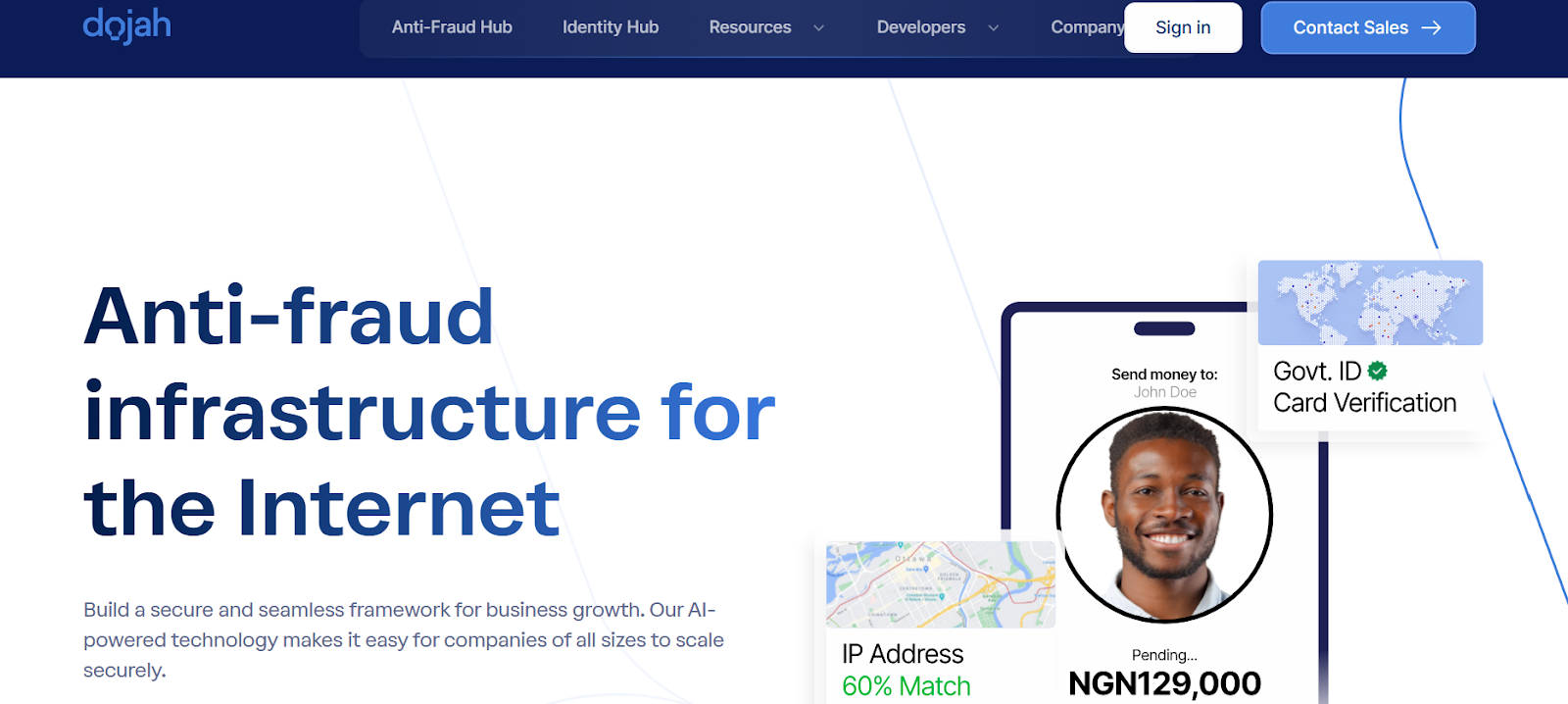
Dojah is an anti-fraud and risk infrastructure platform built for digital businesses across banking, fintech, crypto, and related industries. It combines identity verification and end-to-end fraud monitoring across African countries and international markets. Designed for both startups and enterprises, Dojah enables teams to manage fraud prevention, compliance, and user risk within a single system.
Key Features
- Enhanced Identity Verification: Verify individuals and businesses using government databases, telecom records, biometrics, and watchlist screening across supported African markets.
- Real-Time Data Insights: Track user behavior, drop-off points, and verification performance to gain actionable insights across your onboarding flows.
- Advanced Fraud Detection: Monitor transactions and user behavior in real time across the user lifecycle. Leverage behavioral tracking and dynamic risk scoring to detect suspicious activity early.
- All-in-One Compliance Toolkit: Access KYC, KYB, AML, and fraud checks in a single dashboard, with audit-ready reports and regulatory documentation for easy compliance management.
Pros of using Dojah
1. High Data Accuracy
Dojah connects directly to trusted government databases and extensive data networks across Africa to verify identities against authoritative sources. Users have recorded up to 99.9% data accuracy across supported verification channels. Whether through document checks, OCR, biometrics, or database validation, results remain consistent and aligned with official records.
2. Post-Onboarding Fraud Monitoring
Dojah extends beyond KYC by enabling real-time transaction monitoring through EasyDetect. You can create custom fraud rules, such as flagging transactions above a set threshold, detecting unusual velocity spikes, or identifying abnormal behavioral patterns. This allows your team to act on suspicious activity as it occurs rather than after losses happen.
3. Continuous Risk Assessment
Dojah’s risk monitoring tool, Profiled Risk, helps you maintain visibility into each user across their entire lifecycle. Beyond setting fraud rules, it continuously reviews behavioral and transaction activity to generate a dynamic risk score that evolves. This is particularly useful for platforms handling large transaction volumes, as it provides sustained insight into user risk rather than a one-time assessment.
4. Case Management & Regulatory Reporting
Profiled Risk includes built-in tools for reviewing flagged users, assigning cases, and maintaining decision logs within a centralized dashboard. Fraud and compliance teams can document investigations and manage internal review processes efficiently. Exportable reports such as Suspicious Transaction Reports (STR) for regulatory review are also supported.
5. Ease of Integration & Reliable Support
Dojah is designed for quick implementation, allowing teams to go live in days rather than weeks. You can integrate verification across web, SMS, WhatsApp, and other user channels without overhauling your existing workflow, supported by clear documentation and accessible technical guidance.
Cons of Using Dojah
1. Setup May Require Initial Configuration
While Dojah offers flexibility across identity verification and fraud monitoring solutions, the API setup doesn’t come pre-configured. For non-technical teams seeking a plug-and-play solution, additional technical effort is needed to integrate and customize workflows and thresholds.
2. Government Database Coverage Varies by Country
Dojah provides government database access in 10+ African countries and supports document OCR in over 150 countries. However, access to official databases and verification depth can differ outside these core regions. While document and biometric checks remain available globally, direct government data integration is limited in locations outside Africa.
Seamfix Overview
Seamfix is an identity management and digital verification company that helps organizations capture and manage user identities at scale. It provides biometric enrollment and identity verification solutions across sectors such as telecommunications, banking, fintech, and government services.
With a presence across African markets in countries like Nigeria, Kenya, and South Africa, Seamfix helps businesses build secure onboarding systems and verify users at scale.
Key Features
- Biometric Enrollment & Identity Verification: Capture and verify user identities using facial recognition, fingerprint scans, and document validation through solutions like BioSmart X and Seamfix Verify.
- Government & Enterprise Integration: Connects with national ID systems and enterprise databases to support telecoms, banks, and other large organizations with solutions like GovSmart.
- Customizable Verification Workflows: Supports both offline, field-based enrollment and digital onboarding to fit different operational needs.
- Public Service Identity Management: Enables large-scale citizen programs like passport issuance, voter registration, and social welfare applications through GovSmart.
Pros of using Seamfix
Wide African Regional Coverage
Seamfix provides identity verification services across multiple African markets, including Nigeria, Kenya, South Africa, and others. This regional presence allows organizations to expand onboarding across countries with locally adapted processes and data integrations.
2. Comprehensive Identity Verification Solutions
Seamfix offers a range of tools, including biometric verification, document checks, and citizen identity programs, supported by robust infrastructure like BioSmart X and GovSmart. This combination enables your organization to manage identity verification efficiently, whether for high-volume national operations, field-based enrollment, or industry-specific compliance needs.
3. Regulatory Compliance
Seamfix aligns with global and regional compliance standards and maintains certifications related to security and data privacy. This enables your organization to meet regulatory requirements confidently and build trust when verifying user identities.
4. Telecom-Specific Fraud Prevention
Seamfix’s systems support telecom onboarding use cases such as SIM registration and identity validation via phone number. This helps identify duplicate identities and inconsistencies in subscriber data during enrollment, contributing to more reliable verification in large-scale telecom programs.
Cons of Using Seamfix
1. Limited Fraud Coverage Beyond Onboarding
Seamfix’s fraud prevention is strongest at the enrollment stage, helping you verify user identity before access is granted. However, once a customer is onboarded, there is limited support for continuous risk monitoring, behavioural fraud detection, or native transaction monitoring. For businesses where fraud risk extends beyond signup, this can create gaps in ongoing compliance and risk visibility.
2. Fragmented Product Stack
Seamfix operates multiple products, including BioSmart X, GovSmart, Fixiam, Verify, and SeamID, each designed for different use cases. For teams looking for a single, unified identity and compliance solution, navigating these separate tools can add integration complexity and operational overhead.
Where Dojah Stands Out
While both Dojah and Seamfix offer identity verification and fraud management solutions, there are key areas where Dojah stands out over Seamfix:
1) Continuous Fraud Monitoring Beyond Onboarding
Unlike Seamfix, Dojah supports ongoing risk monitoring after onboarding through tools like EasyDetect and Profiled Risk. It provides insight into user risk profiling, transaction activity, and behavioural patterns across the entire user lifecycle. This gives businesses visibility into fraud risks beyond the initial signup stage and supports more informed decision-making as they scale.
2) Faster Fraud Investigation and Audit-Ready Reporting
Dojah’s Profiled Risk includes built-in case-management tools that enable teams to review and resolve flagged activities within a centralized system. You no longer need to juggle multiple tools or manually compile reports, saving time and reducing errors. This helps you respond to suspicious activity quickly while maintaining a clear audit record.
3) Unified Compliance Stack
Dojah brings together KYC, AML checks, fraud monitoring, and transaction monitoring within one platform. This reduces the need to manage multiple tools or vendors across different compliance functions. As a result, integration and operational complexity are easier to manage.
4) Developer-First Experience With Reliable Support
Dojah is designed for faster implementation, with self-serve APIs, SDKs, no-code widgets, and a sandbox environment for testing. Teams can integrate and go live without long sales cycles. Ongoing technical support also ensures smooth operations when scaling verification and fraud monitoring across your platform
Which African KYC API Solution Is Best for You?
Seamfix is a good option for businesses that need wide-ranging identity verification across African markets, particularly telecoms and government agencies that require biometric enrollment and SIM fraud prevention. If your primary need is verified identity at the point of onboarding, Seamfix is a suitable choice.
Dojah, on the other hand, is built for businesses that need to go beyond identity verification into ongoing fraud management and full lifecycle compliance. Whether you're a growing fintech or a large-scale enterprise platform, Dojah gives your team continuous risk monitoring and a unified compliance stack all in one place. If you're operating or expanding across Africa and need identity verification plus active fraud defense throughout the customer lifecycle, Dojah is the stronger fit.
To explore how Dojah can help your platform monitor fraud and manage risk throughout the user lifecycle, reach out to our team or book a demo to get started.
Start using Dojah for all your business needs


