


Go back to Blog


Jennifer Edidiong
Marketing
8 min read
Share to
How Dojah's Easy Detect Turns Transaction Monitoring Into Real-Time Fraud Protection for African Fintechs

Regulatory expectations for fintechs operating across Africa, and specifically in Nigeria, have changed. New CBN guidelines make it clear: financial institutions are required to integrate automated transaction monitoring directly into their digital systems to protect consumers.
This is no longer something only larger, more mature companies bother with. It is now a baseline requirement and a regulatory mandate. In a market growing as fast as Africa's, user trust is everything, and the rapid spread of digital financial services brings real exposure to fraud and human error. Left unchecked, these risks can quietly push new users away just as they're starting to trust digital platforms.
To scale safely, fintechs need a security layer that catches problems before they become losses. Transaction monitoring is that layer, an automated system that continuously checks activity against a defined set of compliance and security rules.
The Fundamentals of Automated Transaction Monitoring
Transaction monitoring is the process of reviewing financial and operational data in real time to check for safety, legitimacy, and regulatory compliance. Instead of relying on after-the-fact audits or manual spot checks, automated systems evaluate every event as it happens, running it through rules set by the business.
Here's what that looks like in practice. A fintech might set a rule: if a transaction happens at night and exceeds ₦2 million, flag it. When a transfer matches those exact conditions, the monitoring system catches it immediately.
[User Initiates Transaction]
│
▼
[Transaction Monitoring Solution] ──(Passed Through Custom Rules & AI)
│
├──► Action 1: Allow (Low Risk)
├──► Action 2: Pending for Review (Medium Risk)
└──► Action 3: Block (High Risk)
Once a transaction passes through the rule engine, the system responds instantly, in one of three ways:
- Allow: The transaction meets all safety parameters and proceeds without disruption.
- Pending: The transaction shows anomalies and is held for manual review.
- Block: The transaction shows clear fraudulent characteristics and is stopped outright.
Hard-coded rules catch explicit violations, but modern transaction monitoring also runs AI and machine learning alongside them. This catches transactions that drift from a user's normal behaviour, the kind of evolving fraud pattern a fixed rule alone would miss.
Related: What African Fintechs should look for in a transaction monitoring solution
The 0-100 Risk Scoring Scale
Every transaction processed gets assigned a risk score, a number from 0 to 100 that gives an instant read on how risky the event is.
Risk Score Range | Risk Classification | Typical System Response |
| 0 to 39 | Low Risk | Transaction is automatically allowed |
| 39 to 79 | Medium Risk | Transaction is placed in pending status for compliance triage |
| 79 to 100 | High Risk | Transaction is immediately blocked |
These thresholds are a starting point, not a fixed rule. Fintechs can adjust the scale based on regulatory changes, internal risk tolerance, or the specific market they operate in, whether that's everyday payments, credit, or crypto.
Applying these scores consistently does two things: it keeps fraudulent activity to a minimum, and it builds a behavioural history on each user over time. A customer's risk level shifts as their activity accumulates, low, medium, high, or very high risk, giving compliance teams a clear, data-backed read on user behaviour across the platform.
What a Properly Configured Monitoring System Needs
A transaction monitoring tool can't just be one unorganized feed of data. To actually work, it needs structure that matches how a fintech actually operates.
Workspace separation and clear roles: Fintechs rarely do just one thing, they handle onboarding, transfers, and credit all at once. Separate, dedicated workspaces keep these operations from bleeding into each other, so each part of the business gets proper oversight.
A rules editor with live publishing: Compliance requirements change quickly. A good system lets compliance officers add, edit, or remove rules themselves, and publish those changes live without needing an engineering cycle every time.
Alerting and case management: When a transaction lands in pending status, the system needs to notify the right people immediately, and it needs a case management space where those pending events become organised cases. Compliance teams can review the details there and file reports to regulators, including LFI frameworks in Nigeria or equivalent bodies elsewhere on the continent.
Inside Easy Detect: Flows and Core Use Cases
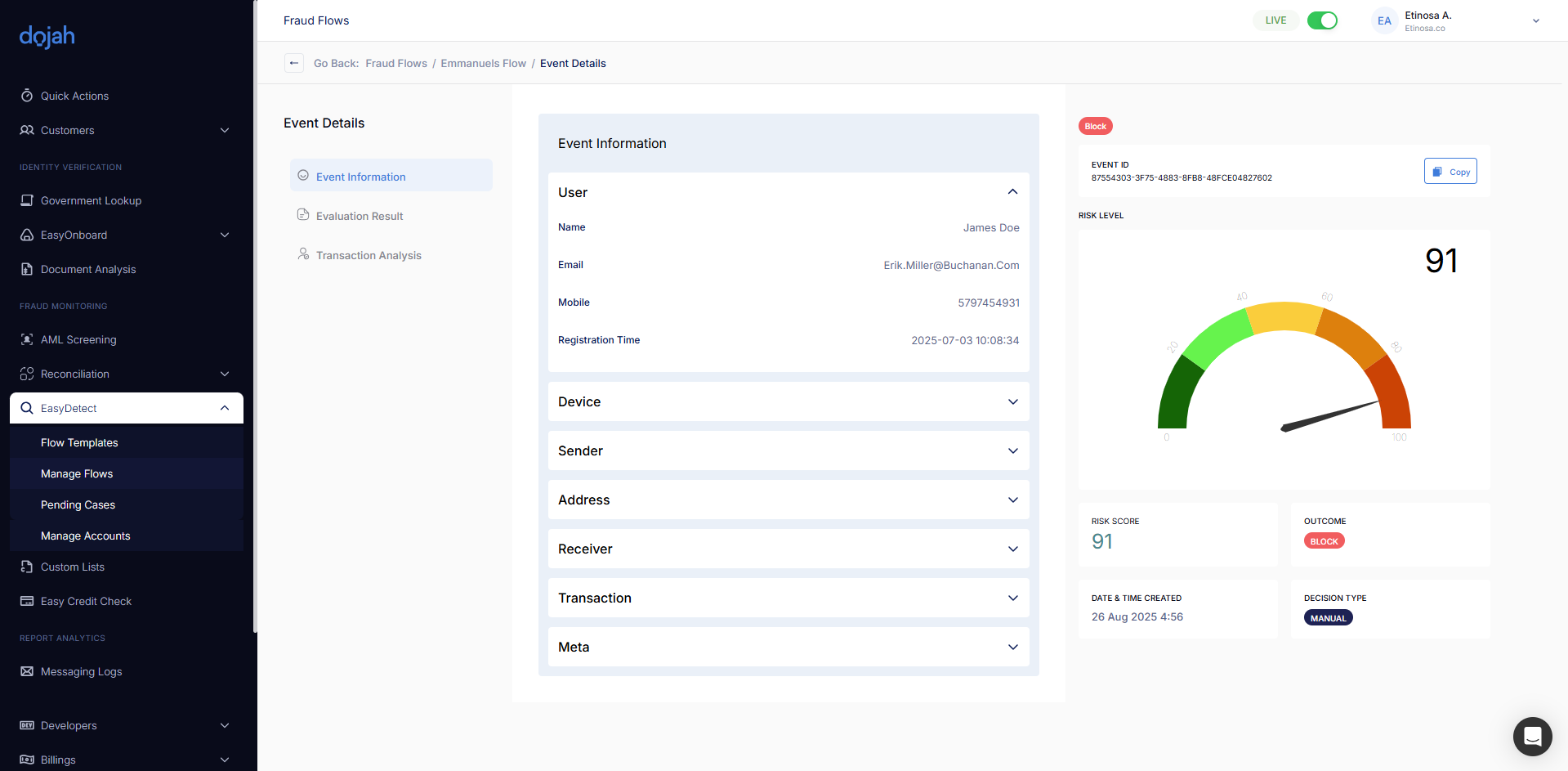
Easy Detect, Dojah's transaction monitoring product, is built to handle exactly this. It organises monitoring environments using flows, dedicated, isolated workspaces where a company sets up its own rules for a specific part of the business.
Flows map to four core use cases:
Onboarding: Tracks activity at the point of entry, registrations, logins, PIN changes, password resets, to catch account takeovers or fraudulent profile creation early.
Banking: Covers core financial movement, deposits, withdrawals, and inter-bank or intra-bank transfers.
Payments: Covers non-bank-to-bank activity, airtime purchases, data bundle subscriptions, and card transactions.
Lending: Covers credit applications, loan disbursement, and repayment behaviour, catching the fraud patterns specific to digital lending.
Choosing the right use case for each flow makes sure the rules being written actually match the data coming through.
How Easy Detect Calculates a Final Risk Score
When an event hits Easy Detect through the API, it's checked against every rule in that flow. Since each rule carries its own risk score, a single transaction can sometimes trigger more than one rule at once.
To resolve that, Easy Detect averages the scores across every triggered rule to produce one final risk score for the transaction.
[Incoming Event]
│
├──► Matches Rule A (Score: 40)
├──► Matches Rule B (Score: 80)
│
▼
[Calculated Average Score: 60] ──► [Action: Move to Pending Case]
If that average lands in the medium-risk range, the event moves to pending and a case is generated automatically. At the same time, an alert goes out, either by email or webhook, a real-time system-to-system notification that lets the fintech's internal tools react instantly.
Once a case lands in the dashboard, a human compliance officer takes over. They review the event, the context behind it, and decide to allow or block the transaction. Before a case can close, the officer has to write a clear, documented reason for that decision. That record stays visible to anyone on the team with the right permissions.
Easy Detect is also building toward AI-assisted case review, currently in background testing, where machine intelligence will pre-audit cases before a human makes the final call.
Profile-Based Monitoring
Most transaction monitoring tools look at data in isolation, numbers, timestamps, and values, with no connection to the person behind them.
Easy Detect connects transaction activity directly to identity data instead. Every user gets a persistent profile, and every transfer, login, or purchase they make gets recorded against that profile.
This changes what compliance work actually looks like. Instead of reviewing a disconnected alert, a compliance team sees a behavioural timeline, the user's overall risk score, built from everything they've done on the platform.
Easy Detect sorts users into four tiers:
- Low-risk
- Medium-risk
- High-risk
- Very high-risk
Where a user lands depends on two things: how many pending cases have built up against their profile over time, and the background analysis run by Easy Detect's ML models. Every alert a compliance team sees comes with that history already attached, not as an isolated, context-free flag.
Setting Up Easy Detect via API
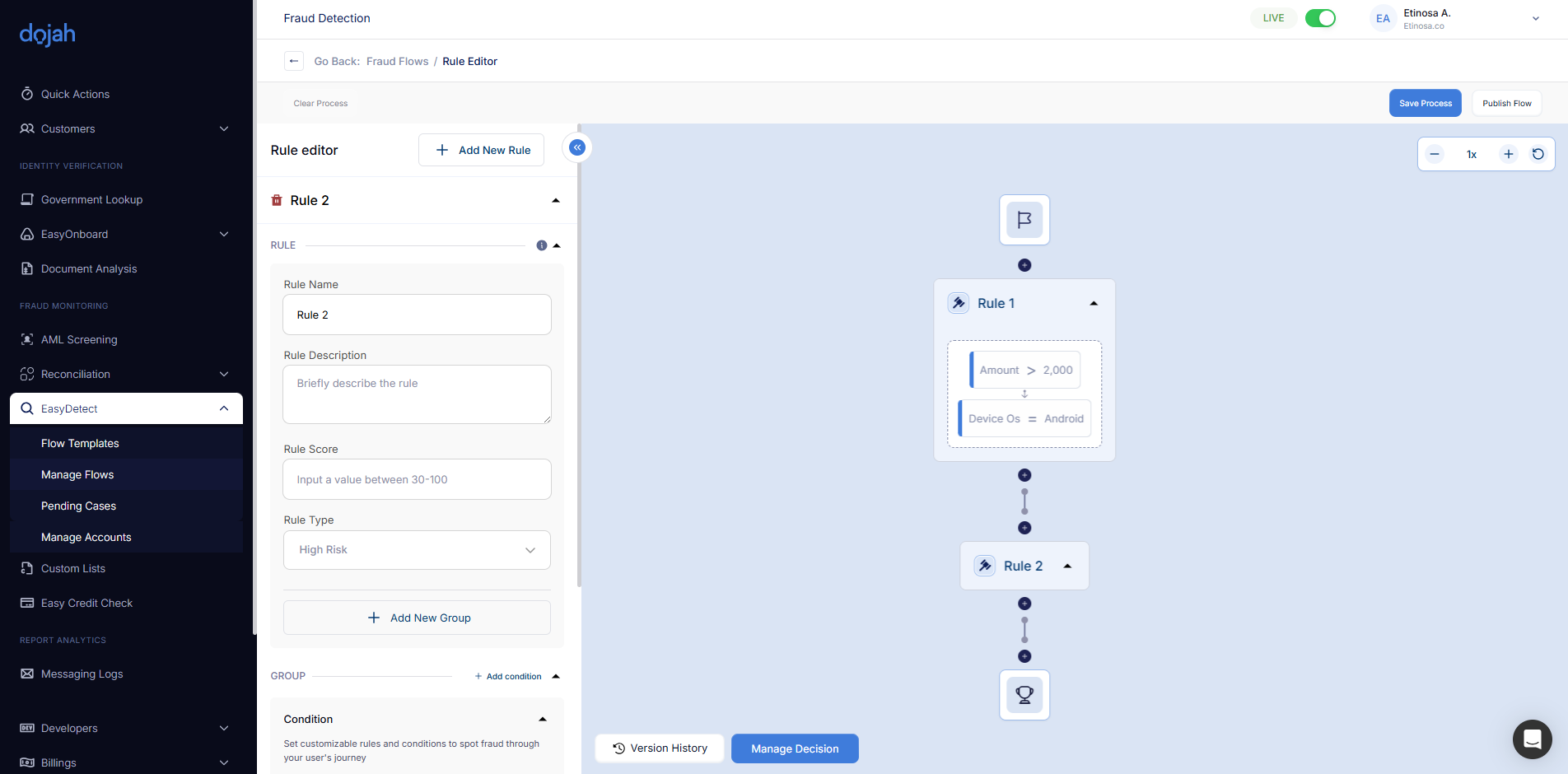
Integrating a security layer into an existing codebase can normally take weeks. Easy Detect is built to avoid that, with a setup process that takes minutes, not weeks.
1. Create a flow and get your keys
A developer logs in and creates the flows they need, a Banking flow, an Onboarding flow, whatever fits. Each flow comes with two keys:
- Real-Time Key: streams live transactions to Easy Detect for instant evaluation
- Backfill Key: uploads historical transaction data, so Easy Detect's AI can build behavioural context on existing users right away. If historical data isn't available, the system builds that history from scratch as live events come in.
2. Send structured JSON events
With keys ready, the development team sends transaction data to the Easy Detect API as JSON, a simple, readable format used to pass data between systems. For example, a fund transfer gets packaged with the amount, time, and user ID, then sent through the API.
3. Get a decision in milliseconds. Easy Detect processes the data against the active rules and ML models within milliseconds, returning a risk score and a decision: Allow, Pending, or Block. If a case is triggered, any system listening on the configured webhook picks up the alert instantly, so internal tools and compliance queues update in real time.
Easy Detect is built to remove the engineering overhead that usually comes with adding a security layer, so growing African fintechs can meet regulatory requirements and build trust with their customers from day one.
Getting Started
You can sign up for a free Dojah account at app.dojah.io/signup and start building in the sandbox environment right away, no production credentials required to begin. Once you're ready to go live, you move to production using the same API endpoints, no rework needed.
For the full integration walkthrough, including how to create flows, configure rules, and structure your JSON payloads, the Easy Detect documentation has everything your team needs to get this running in minutes, not weeks.
Start using Dojah for all your business needs


