


Go back to Blog


Jennifer Edidiong
Marketing
10 min read
Share to
How to Choose the Best Identity Verification Provider for Your Logistics Platform

A rider from a logistics platform picks up a package for delivery, and a few hours later, delivery hasn't been made, with no way to trace the rider's identity beyond basic contact details. The package is gone, and the logistics platform could be liable for any loss or damage incurred. This is not an unusual pattern but a common scenario that plays out among riders and logistics businesses across Africa. This lack of proper rider verification poses a real gap in trust and safety for the business and its end users.
The logistics industry across Africa is expanding rapidly, with last-mile delivery and dispatch services growing alongside rising e-commerce demand. As order volumes grow, so does the need to know exactly who is picking up and delivering on your behalf, for the safety of your customers and the protection of your platform.
As a logistics or dispatch business owner, identity verification may sound complex, something built for fintechs with developers and compliance teams on staff, not a business owner managing riders across a growing fleet. The real question on your mind is probably whether proper verification is even possible without a technical team.
We answer that in this guide and walk you through how to choose an identity verification provider for your logistics platform, without needing a technical team.
The Real Risk Logistics Businesses Are Carrying Without Verification
Most riders, couriers, and delivery partners are onboarded with nothing more than a name and a phone number. That alone creates several risks for a logistics business:
- Riders or couriers absconding with goods: A rider who disappears with a package is genuinely hard to trace without a verified identity on file. For example, in cities like Lagos, there have been reported cases of riders vanishing mid-delivery with goods, leaving the business owner with nothing but a phone number that eventually stops working.
- Fraudulent pickup requests using fake or stolen identities: Someone posing as an authorised rider or partner can intercept or redirect a shipment before it ever reaches the customer. A platform with no real verification in place has no way to catch this before the goods are gone, since the only thing standing between the package and the wrong hands is a name nobody has actually confirmed.
- Identity theft used to secure a rider or delivery position: A person using a false or stolen identity to get onboarded as a rider creates liability that traces straight back to the business. If something goes wrong on a delivery made under that identity, the business is left answering for someone it never actually verified in the first place.
- No real record to fall back on when something does go wrong: Whether it is theft, a customer dispute, or a serious incident on the road, a business with no verified identity record has nothing concrete to hand to the authorities.
Most logistics businesses only start looking for a real verification provider after one of these has already happened to them.
Why Most Verification Platforms Don't Fit a Logistics Business

Most identity verification platforms on the market were never built with a delivery or dispatch business in mind, and that becomes obvious the moment you start evaluating one.
- Built for developers, not dispatch managers: Most platforms assume an engineering team will integrate an API. A logistics business needs something a non-technical operations manager can set up and run themselves, without waiting on anyone to build it.
- Built for compliance teams, not riders on the road: Verification flows designed for fintech KYC assume a desk-based customer sitting down to complete a form. A rider needs to verify in a few minutes, between deliveries, on a basic smartphone, not at a desk.
- Priced for enterprise volume, not a growing dispatch fleet: Enterprise pricing models built for banks and large fintechs do not match the scale or budget of a logistics business onboarding riders in small batches as it grows, often a handful at a time, not hundreds.
None of this means logistics businesses don't need real verification. It means most providers were never built with this use case in mind, which is exactly why knowing what to look for matters.
What to Look for in a Verification Provider for Logistics
By now, the need for a real verification provider is already clear. The next step is knowing what to actually look out for when evaluating one, since it is important to find something built for your logistics platform, not just a generic KYC provider.
1. No-code setup: As a logistics business moving goods and onboarding riders regularly, you don't have time for a complex setup process that needs a developer every time you want to make a change. You need a no-code platform that lets you build and adjust your verification flow yourself, so onboarding never depends on external factors.
2. Launch speed: A provider that takes weeks to implement is the wrong fit for a business that onboards riders continuously. You need something you can be running within minutes of signing up without a delay in your setup process.
3. No app download for your rider or courier: You also need a verification system that fits naturally into how your riders already work, not one that adds another app to their phone before they can start a single delivery. Verification should run through a simple link that your rider opens in their own browser and completes in minutes.
4. African ID and country coverage: The provider needs to verify against real Nigerian and broader African ID systems, not a generic global check that fails to recognise local ID formats. A rider with a valid national ID should not get flagged simply because the system was never built to read it.
5. AML and watchlist screening, where you need more than a basic ID check: For logistics businesses handling higher-value goods or operating at scale, screening riders or partners against watchlists adds a layer that basic ID verification alone does not cover. This matters more as the value of what you're moving goes up.
6. A trust score: You should get a clear verification result that you can apply. The result should tell you directly whether to proceed, ask follow-up questions, or decline, without needing someone on your team to make that judgment call manually every time.
7. An audit trail you can search later: If a dispute or theft happens, you need to be able to pull up exactly what was verified, when, and what the result was. Without that record, you are left trying to piece together what happened after the fact, with nothing solid to point to.
Weighing These Criteria Against How Your Business Actually Operates
Not every logistics business leans on the same features the same way. The right priorities depend on what you're actually moving and who you're onboarding, so it helps to know where your business fits.
- A delivery or dispatch company verifying riders continuously: Launch speed matters more here than almost anything else. You're onboarding new riders on an ongoing basis, sometimes weekly, sometimes daily, and a slow process repeated that often will hold back your operations far more than it would for a business onboarding in occasional batches.
- For a logistics business handling higher-value goods: AML and watchlist screening carry more weight for you. Moving expensive freight or sensitive goods comes with a different risk profile than standard last-mile delivery, and that extra layer of screening matters more the higher the stakes get.
- A platform connecting independent riders to customers: A clear pass, flag, or fail result with a trust score matters most for fast activation. You need a confident decision the moment someone signs up, so onboarding does not stall waiting on a manual review before a rider can start working.
Every logistics business benefits from a no-code setup and a verification flow that riders can complete without an app, and that is exactly where CheckIn fits.
Why CheckIn by Dojah Is Built for This Gap
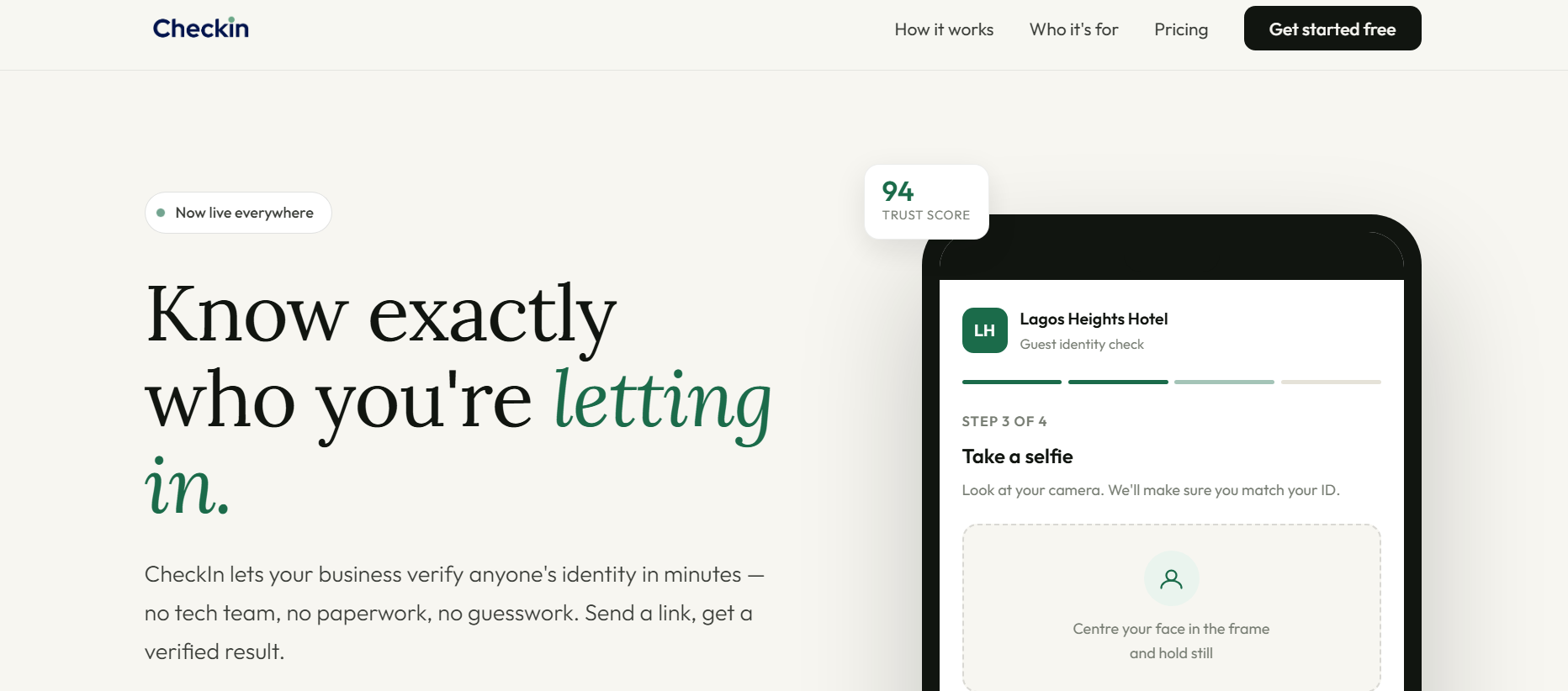
As a no-code identity verification tool built to help logistics and delivery businesses across Africa verify riders easily, here's how CheckIn by Dojah closes the gap covered in the checklist above:
- No code, set up from a dashboard: You create your verification flow yourself, with no developer or technical team needed at any point.
- Riders verify on their own phone, no app required: A link, a government ID photo, and a quick selfie, done in minutes, with nothing for your rider to download or install.
- Built for African identity infrastructure: Verification runs against real Nigerian and broader African ID systems, so a rider's actual ID gets recognised and checked properly.
- AML screening included: For logistics businesses that need more than a basic ID check, watchlist screening is part of the same flow; no separate tool is required.
- Results in your dashboard, searchable later: If a dispute or incident happens, you have a real record to go back to, not just a name and a phone number.
CheckIn gives any logistics business in Africa, whether you're running a dispatch fleet or a delivery platform, the same level of identity verification that used to require a developer team, now accessible directly from a dashboard.
FAQS
1. What's the difference between checking a rider's ID by eye and actually verifying it? Looking at an ID confirms someone handed you a card. Verifying it means checking that ID against the actual issuing database, confirming it's real, and matching it to a live selfie of the person holding it. One gives you a glance. The other gives you a record you can stand on later.
2. How fast can I get a rider verified and working? With a no-code provider like CheckIn, a rider opens a link, photographs their ID, takes a selfie, and gets a result back in minutes, all from their own phone. There's no manual review holding things up, so you're not waiting days to get someone on the road.
3. What happens if a rider disputes something or disappears with goods? If you've verified them properly, you have a real identity record to hand to the police, not just a name and a phone number that may not even be real. Without that record, you're left doing your own informal tracking, with no guarantee of getting anywhere.
4. Can I verify riders who only have a national ID, not a passport?
Yes. A good provider checks against the actual government databases that issue national IDs, driver's licences, and other local documents, not just passports. As long as the ID is real and the database exists, it can be verified.
Start using Dojah for all your business needs


