


Go back to Blog


Jennifer Edidiong
Marketing
7 min read
Share to
Identity Verification for Payment Providers in Africa

A payment provider is not only responsible for verifying individual customers. It also needs to verify the merchants using its platform, including the businesses and people behind them. A strong customer KYC process does not automatically cover merchant verification.
Missing either side can leave gaps in the platform’s compliance process. The CBN’s March 2026 Baseline Standards require licensed PSPs to deploy automated AML transaction monitoring. This extends the compliance picture beyond onboarding to the activity and risk associated with customers and merchants.
This guide explains what identity verification for payment providers in Africa actually requires across both obligations and what to consider when building an effective verification process.
What Payment Provider Verification Entails
A payment provider is not only verifying the people who use its platform. It also needs to verify the businesses receiving payments through it. These are two different verification obligations, so applying the same KYC process to both can leave gaps.
Here’s what each obligation covers:
- 1. The Customer Obligation
Individual customers are verified under the CBN’s tiered KYC framework. Depending on the tier, checks can include BVN or NIN, government-issued ID, and address verification, with stronger requirements as transaction access increases.
2. The Merchant Obligation
Verifying the person who submits a merchant application is not enough. You also need to verify the business, its directors, and ultimate beneficial owners, then assess the relevant AML risk. The CBN’s March 2026 Baseline Standards also require AML monitoring to consider transaction activity alongside KYC/KYB information and customer risk profiles.
These two obligations solve different verification problems. The next step is to look at what individual customer verification requires in practice.
Verifying Individual Customers
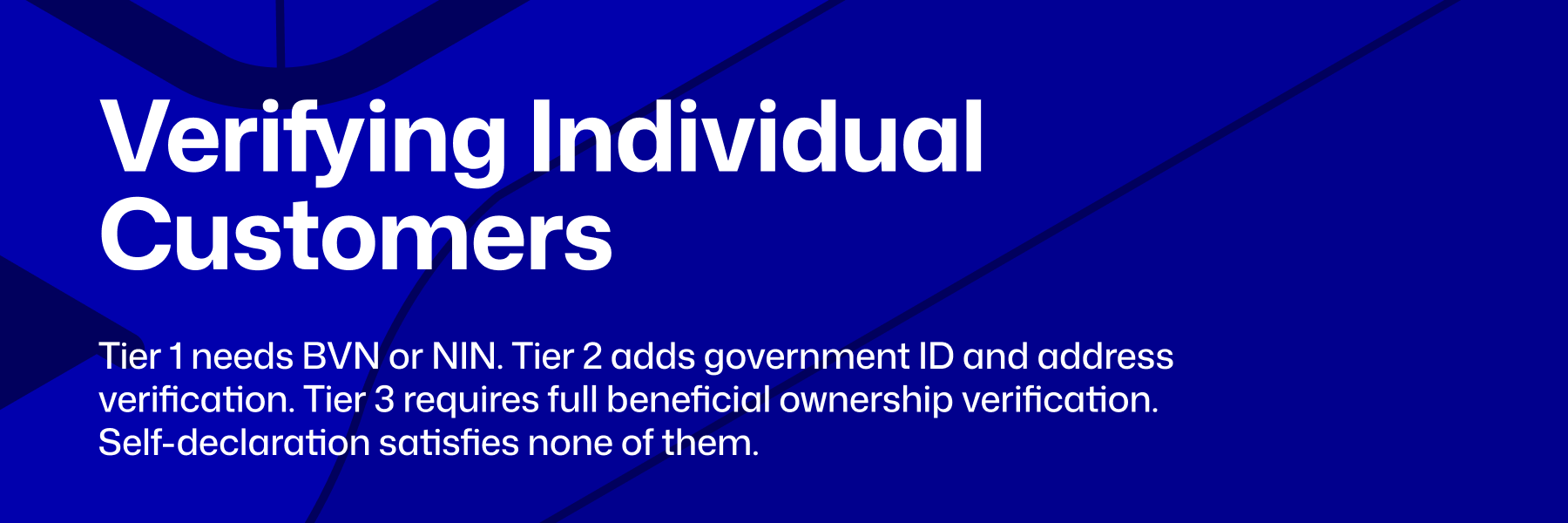
For payment providers, individual customer verification follows a tiered approach. The checks required depend on the customer's account or wallet tier, so the verification process needs to match the level of access being provided.
Here’s what that looks like in practice:
- Tier-Based KYC: CBN requirements differ by tier. Tier 1 individual accounts and wallets require BVN or NIN, while Tier 2 and Tier 3 require both BVN and NIN. CBN also requires onboarding to retrieve this information electronically from the relevant databases.
- Liveness and Face Match: Higher-risk onboarding may require more than confirming that an identity record exists. Liveness checks that a real person is present, while face matching compares that person with the ID photo, helping confirm that the person presenting the identity is its rightful holder.
- Monitoring After Onboarding: Verification does not end when an account is approved. The CBN's March 2026 Baseline Standards require AML monitoring to connect transaction activity with KYC/KYB information, customer risk profiles, and expected activity.
Individual verification is only one side of the payment provider's obligation. Merchant verification is where the other side begins.
Verifying Merchants
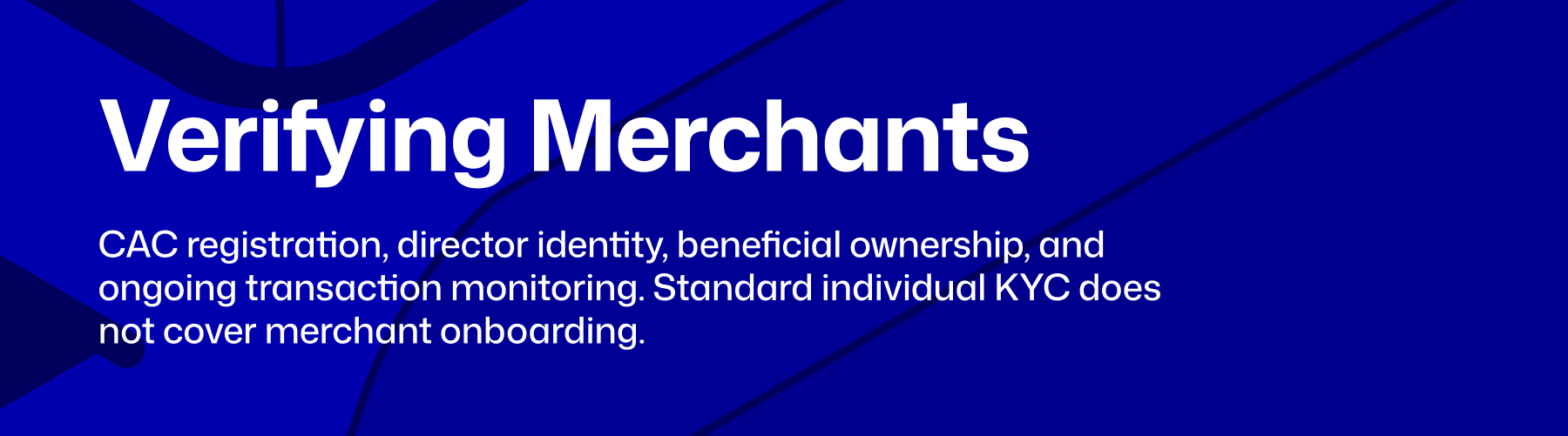
A payment provider onboarding a merchant is onboarding a business customer, not just the person filling out the application. The verification process needs to establish the business, the people behind it, and the risks attached to the relationship.
The key checks include:
- Verify the Business: Start with the Corporate Affairs Commission (CAC) to confirm that the merchant is registered and that its business details are valid. This helps you confirm that the business exists before onboarding it.
- Verify the Directors: Verify the identity of the merchant’s directors and screen them against PEP, sanctions, and adverse media lists. Checking only the business entity can miss risks linked to the people who control it.
- Identify the Beneficial Owners: You also need to establish who ultimately owns or controls the business. Identifying and verifying the ultimate beneficial owners (UBOs) gives you a clearer view of who is behind the merchant.
- Monitor Merchant Activity: Verification does not stop when the merchant is approved. The CBN’s March 2026 Baseline Standards require AML monitoring to assess transaction activity alongside KYC/KYB information and customer risk profiles.
Merchant verification requires more than individual KYC. The next step is choosing the right verification partner.
What to Look for in an Identity Verification Partner
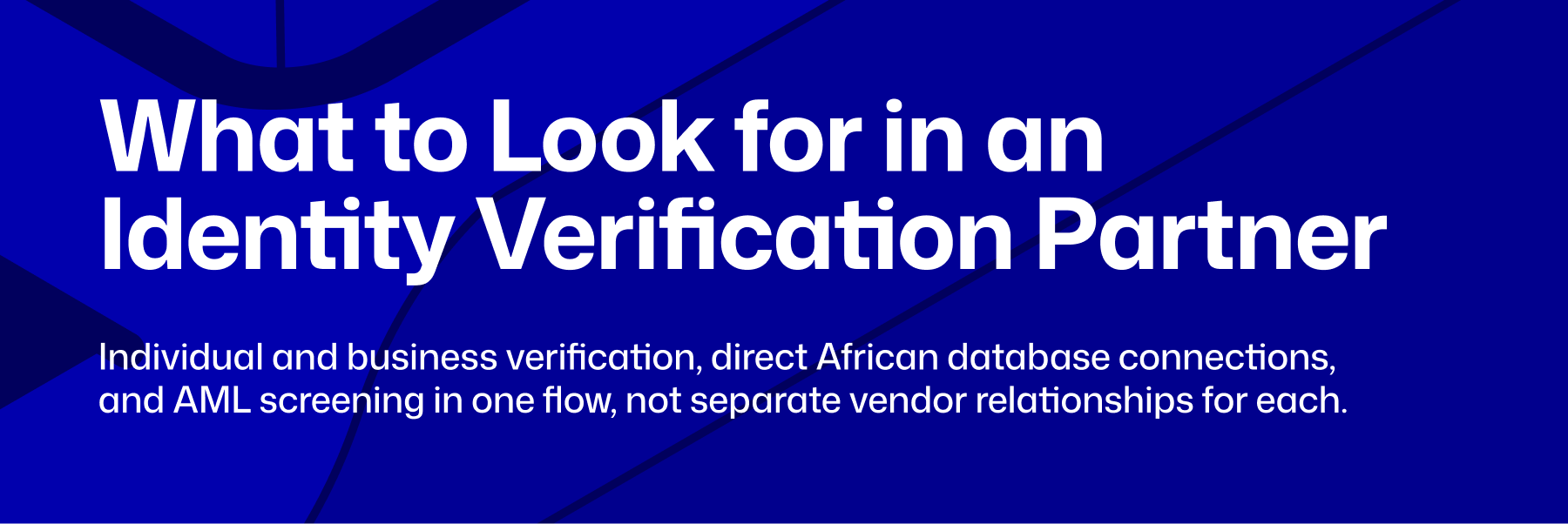
A payment provider needs a verification partner that can cover both individual customers and merchant businesses. A solution built only for individual onboarding can leave gaps in merchant verification.
Look for three capabilities:
- Individual and Business Verification: The partner should handle government ID checks, liveness, and face match for individuals, alongside CAC verification, director checks, and UBO identification for merchants. This keeps both verification needs within one integration.
- Direct Database Connections: For payment platform identity verification in Nigeria, look for direct connections to BVN, NIN, and CAC databases. This lets you verify records against the relevant source instead of relying only on documents submitted by the customer or merchant.
- Integrated AML Screening: AML screening should be part of the same verification flow. Sanctions, PEP, and adverse media checks can then run alongside identity verification without requiring a separate process.
This is what Dojah’s identity verification infrastructure is built to provide for payment providers.
How Dojah’s Identity Verification Infrastructure Supports Payment Providers
For payment providers in Africa, identity verification needs to cover both individual customers and merchants. The checks differ, but they still need to work within the same compliance process. Dojah’s EasyOnboard brings both sides together in one platform.
Here’s how it supports both sides:
- Individual customer verification: EasyOnboard supports BVN and NIN verification, government ID and address verification, liveness, and face match. This allows you to build verification flows around different CBN customer tiers.
- Merchant verification: You can verify CAC registration, directors, and beneficial owners, while running AML screening on the merchant as part of the same flow.
- AML screening: Dojah’s AML Watchlist checks sanctions, PEP, and adverse media for both individuals and merchant entities. Screening can therefore run alongside identity verification rather than as a separate process.
- Transaction monitoring: After onboarding, Easy Detect provides real-time transaction monitoring. It connects verified customer and merchant information with ongoing transaction activity.
For African payment providers managing both customer and merchant verification, Dojah brings both obligations together in one platform.
Explore Dojah’s EasyOnboard to simplify identity verification for your payment platform.
Frequently Asked Questions About Identity Verification for Payment Providers in Africa
1. What does identity verification for payment providers in Africa involve?
It involves verifying individual customers and merchant businesses. Depending on the risk and regulatory requirements, checks may include ID verification, biometrics, business verification, beneficial ownership, and AML screening.
2. Why do payment providers need to verify both customers and merchants?
Payment providers need to know who is using their platform and who is receiving payments through it. Verifying only customers can leave gaps in merchant identity, ownership, and AML risk.
3. What does KYC for payment providers in Africa require?
The requirements vary by market and customer type. They may include government ID, BVN or NIN verification, address checks, biometric verification, and ongoing monitoring.
4. What should you look for in payment platform identity verification in Nigeria?
Look for a solution that supports the checks your platform needs, including database verification, biometrics, business verification, and AML screening. It should also fit smoothly into your existing onboarding and compliance process.
Start using Dojah for all your business needs


