


Go back to Blog


Jennifer Edidiong
Marketing
8 min read
Share to
Passive Liveness vs Active Liveness: Which One Should African Fintechs Use

When a user submits a selfie during onboarding, your liveness check has one job: to confirm a real person is on the other side of the camera. But how your system asks them to prove that changes two things at once, how many users actually complete the check, and what kind of fraud attempt it can catch.
Passive and active liveness both solve this problem, but they solve it differently. The more important question is what each one actually defends against and where they perform the same, so you can make the right call for your onboarding flow.
This article covers what active and passive liveness are, what genuinely differs between them, and how to know which approach fits your fintech.
What Active Liveness Is

Active liveness is a method of confirming a real person is present by requiring them to perform a specific action during verification. This could involve blinking, smiling, turning their head, or following an on-screen prompt before the system accepts the check as complete.
1. How the check is structured: The system issues a prompt, sometimes called a challenge-response sequence, and the user performs the requested action in real time on camera. The system then verifies that the response matches what was asked for before passing the check.
2. Why it became the industry default early on: Active liveness detection predates passive liveness detection and was the first generation of liveness technology. Early systems needed an active signal to distinguish a real, responsive person from a static photo since simpler systems couldn't yet reliably analyse a single still image.
3. What it reliably defends against: Active liveness consistently defeats basic presentation attacks. A printed photo, a paused video, or a low-quality mask simply cannot perform a requested action in response to a live prompt, which is why this approach became standard for catching straightforward spoofing attempts.
Active liveness solves the basic spoofing problem well, but it asks something of the user every time, and that has a measurable cost
What Passive Liveness Is

Passive liveness is a method of confirming a real person is present using a single image or short video, with no prompts, instructions, or action required from the user at all.
1. How the check is structured: The system analyses signals the user has no conscious control over, such as skin texture, light reflection, depth, and micro-movements invisible to the naked eye, all from a single capture. The user does nothing beyond looking at the camera.
2. Why it's measurably faster than active liveness: With no prompt to issue and no action to wait for, a passive check typically completes in one to two seconds, compared to the longer multi-step process active liveness requires. For users on lower-end devices or slower connections, this difference is especially significant.
3. Why completion rates improve as a result: A 2022 case study by ID R&D involving a large financial services customer found that switching from active to passive liveness increased onboarding completion rates by over 50%, with the firm noting that the impact likely had a similar effect on customer acquisition and revenue.
Related: Facial recognition vs Facematch for African fintechs
What Actually Makes Them Different
The real differences between active and passive liveness come down to two things: how much each asks of the user, and how each performs against the same category of basic spoofing attempts.
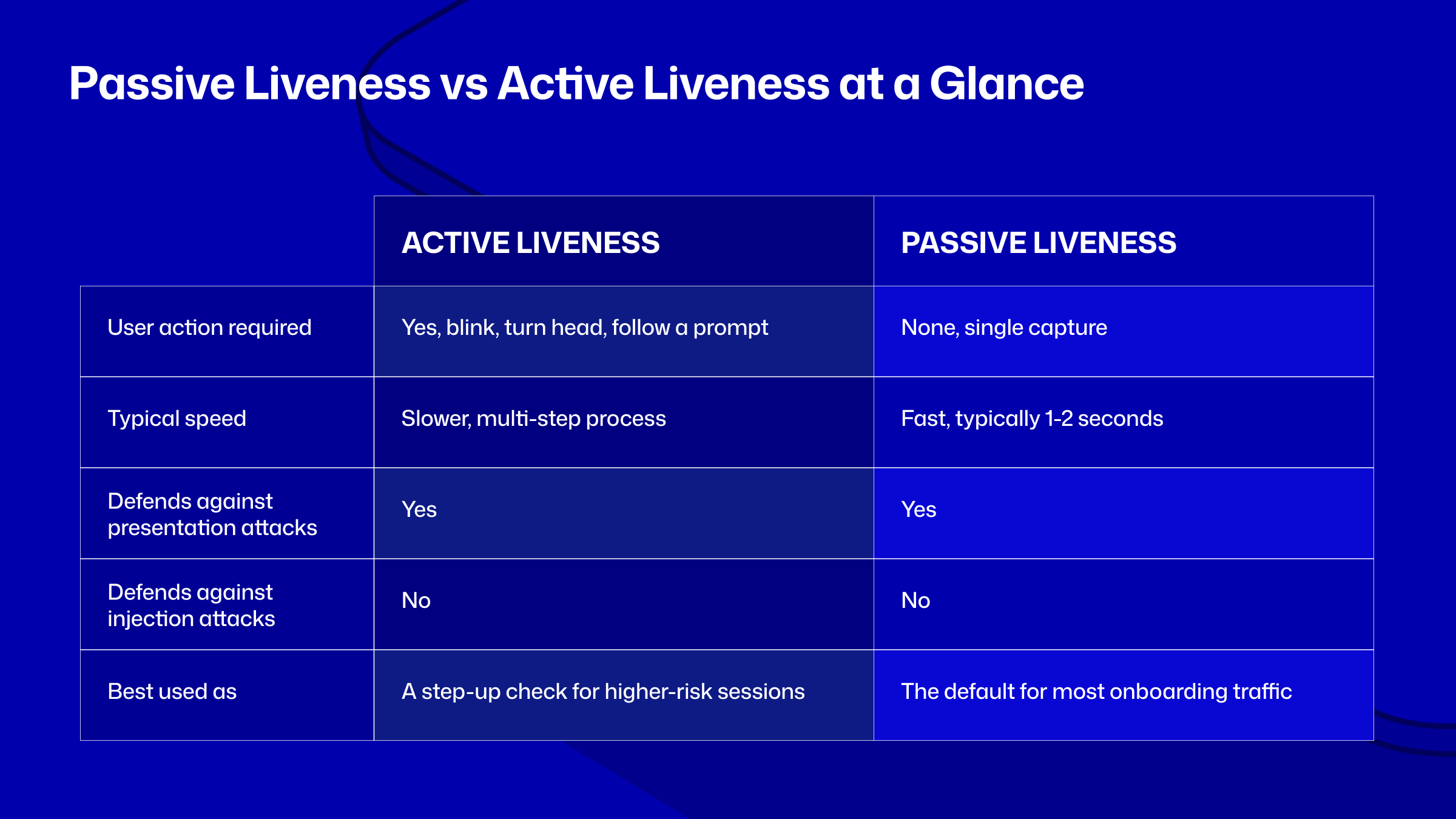
1. Speed and friction: Passive liveness completes in one to two seconds with nothing for the user to do. Active liveness takes longer and requires the user to follow a prompt, a difference that shows up directly in completion rates and onboarding conversion.
2. What triggers the check: Active liveness depends on the user performing a requested action. Passive liveness depends entirely on what the system can infer from a single capture, which places more weight on the strength of the underlying detection model.
3. Performance against basic presentation attacks: A printed photo, a paused video, or a low-quality mask can be caught by either a well-built active or passive system. This is the one area where the two are genuinely comparable rather than meaningfully different, and where the quality of the model matters more than the method.
Laid out side by side, these differences are easy to compare directly:
Passive Liveness vs Active Liveness At a Glance
How to Use Both Liveness Methods in a Layered Approach
The best approach is combining both active and passive checks in a layered detection rather than picking one method exclusively. Here’s how you can apply this:
1. Passive liveness as the default for most users: Since it's faster and causes less drop-off, passive liveness handles the bulk of onboarding traffic without adding friction to legitimate users. For African fintechs onboarding users across varying device quality and network conditions, this matters more than it does in markets with more consistent device environments.
2. Active liveness for higher-risk sessions: When a session shows other risk signals, such as an unusual device, a flagged location, or a pattern matching known fraud attempts, adding an active challenge as a second layer raises the cost of attack for that specific session. This is where active liveness earns its place, not as the default, but as a step-up check matched to risk.
3. Matching the approach to your user base: For African fintechs specifically, the device and connectivity environment is a real consideration. A multi-step active flow that works smoothly on a high-end device may cause a meaningful drop-off on lower-end smartphones or slower connections. Passive liveness as the primary check, with active as a step-up option for flagged sessions, keeps the experience seamless.
This is the kind of layered approach Dojah's liveness check is built around.
How Dojah's Liveness Check Is Built
The right liveness approach for an African fintech is not just a technical decision. Drop-off at onboarding is a real cost, and so is letting spoofed identities through.
Dojah's liveness check is built to close both gaps by combining AI-powered expression-based liveness detection with biometric matching against verified identity documents.
- AI-powered expression detection: Dojah's liveness check analyses human expressions, smiling and blinking, in real time to confirm a live person is present at the point of capture. This defends against basic presentation attacks and raises the bar for straightforward spoofing attempts.
- Biometric matching against ID documents: Facial biometrics captured during the liveness check are matched against the user's provided identity document, confirming the person completing the check is the same person named on the ID.
- Continuous biometric referencing: Facial biometrics are not just captured once. They are continuously referenced for authorising future actions, logins, and account changes, adding an ongoing layer of identity assurance beyond the initial onboarding check.
- Built for African onboarding realities: Dojah's liveness check is built for the device quality, network conditions, and fraud patterns that actually show up in African fintech onboarding.
FAQs
1. What is the difference between passive liveness and active liveness?
Active liveness requires the user to perform a specific action, such as blinking, smiling, or following a prompt, to confirm they are present. Passive liveness confirms presence from a single capture with no action required, using signals the user has no conscious control over.
2. Which is more secure, passive or active liveness?
Neither is simply more secure than the other. Both defend against basic presentation attacks when well-built. The meaningful difference is that passive liveness performs better on speed and completion rates, while active liveness adds a second barrier for higher-risk sessions when used as a step-up check.
3. Why do some fintechs use both passive and active liveness?
Passive liveness handles the bulk of onboarding traffic without adding friction. Active liveness is layered on top for sessions showing higher-risk signals. This approach keeps onboarding smooth for most users while raising the bar for flagged sessions.
4. What should African fintechs consider when choosing a liveness approach?
Device quality and network conditions are real factors. A multi-step active flow that works on high-end devices may cause drop-off on lower-end smartphones or slower connections. Passive liveness as the primary check, with active as a step-up option for higher-risk sessions, tends to fit the African onboarding environment better.
Start using Dojah for all your business needs


