


Go back to Blog


Jennifer Edidiong
Marketing
7 min read
Share to
Tenant Identity Verification: How To Verify Tenants Before Handing Over the Keys

You have done the viewing, agreed on the rent, and the tenant seems genuine. But by the time they default, sublet without permission, or turn out to be someone entirely different from who they claimed to be, the only thing on file is a photocopy of an ID and a phone number that no longer connects.
Unfortunately, situations like this are more common than many property managers would like to admit. The risk starts the moment a tenant is let in without a proper identity check in place. By the time the problem becomes obvious, the tenant has already moved in, making it far more difficult to recover losses or hold anyone accountable.
This article is about closing that gap in tenancy verification across Africa and how to verify tenants properly before handing over the keys, without needing a technical team.
The Risks of Skipping Proper Tenant Verification

Tenant fraud in African rental markets is not a new problem. Some of the risks that show up most often:
1. Double Renting: Without a verified, documented process for confirming who has actually signed for a unit, more than one tenant can end up believing they have secured the same property. For example, two tenants who both paid a deposit and signed informal agreements only discovered the conflict on moving day.
2. Disappearing Tenants: A tenant onboarded without real identity verification is much harder to trace or hold accountable if they stop paying rent and leave. There is often nothing on file beyond a name and a phone number that may not even be genuine, making any attempt to follow up or pursue the matter challenging.
3. Occupancy Disputes: Without a verified record of who actually signed the lease, disputes over who is legally responsible for a unit become difficult to resolve. For instance, where informal subletting has occurred, a property manager may have no way to confirm who was actually occupying the unit when damage happened or when rent stopped coming in.
4. Informal checks leave no real record: A photocopy confirms a document was handed over. A verbal assurance confirms nothing at all. If a dispute or serious incident arises months into a tenancy, a property manager working from photocopies and word of mouth has nothing concrete to retrieve, present to authorities, or use to hold anyone accountable.
5. A real document doesn't confirm who is holding it: A valid ID does not confirm the person presenting it is actually the person named on it. Someone using a borrowed or stolen ID can hand over a legitimate document and still pass a manual check. Identity theft and impersonation both rely on exactly this gap.
Proper tenant verification is not about slowing down the rental process. It is about having something real on file before the keys change hands. Fortunately, modern identity verification makes it possible to achieve this without making the rental process more complicated for either property managers or tenants.
Related: How to do guest ID verification without a technical team
What Proper Tenant Verification Looks Like and How It Fits Your Process
Here’s how proper tenant identity verification works without disrupting your existing sign-up process:
1. A government-backed ID check confirms the document is real: Once a prospective tenant is ready to proceed, the property manager sends a verification link. The ID submitted through it is checked against the actual issuing database, confirming it genuinely exists and hasn't been altered or fabricated. This is the step no photocopy can replicate.
2. A selfie and liveness match confirm who is actually holding it: In the same flow, on their own phone, the tenant captures a live photo, which is then matched against the ID. This confirms the person applying to rent the unit is the same person named on the document, not someone using a borrowed or stolen ID to get through.
3. The check happens in minutes: There's no separate appointment or office visit required. The tenant completes both steps from wherever they are, usually in under five minutes, on any phone with a camera and a browser.
4. The result is back before the key changes hands: The property manager has a clear answer ready before any commitment is made. The process adds no real delay; it runs alongside the same steps that were already happening.
All of this only works if it's genuinely simple to set up, which is exactly the part most property managers assume requires a developer.
How to Do This Without a Technical Team
Most property managers assume real identity verification means hiring a developer, integrating an API, or adopting enterprise software. However, you can carry out verification without needing a technical setup:
1. No-code tools now exist for exactly this use case. Verification can be set up and run entirely from a dashboard, no API, no integration project, no developer required at any point. If a tool still asks you to involve a developer to get started, it hasn't solved the problem.
2. Setup can take minutes: A property manager can create an account and have a verification flow ready to send to their next prospective tenant the same day. No onboarding process takes weeks or a technical team to configure.
3. No technical hosting needed: Unlike a full software platform, there is no ongoing technical upkeep on your side. The dashboard and the verification flow are simply ready whenever you need them.
And you can do all of this without a developer or a technical team. CheckIn is the tool that makes it possible.
How CheckIn Makes It Easy to Verify Your Tenants
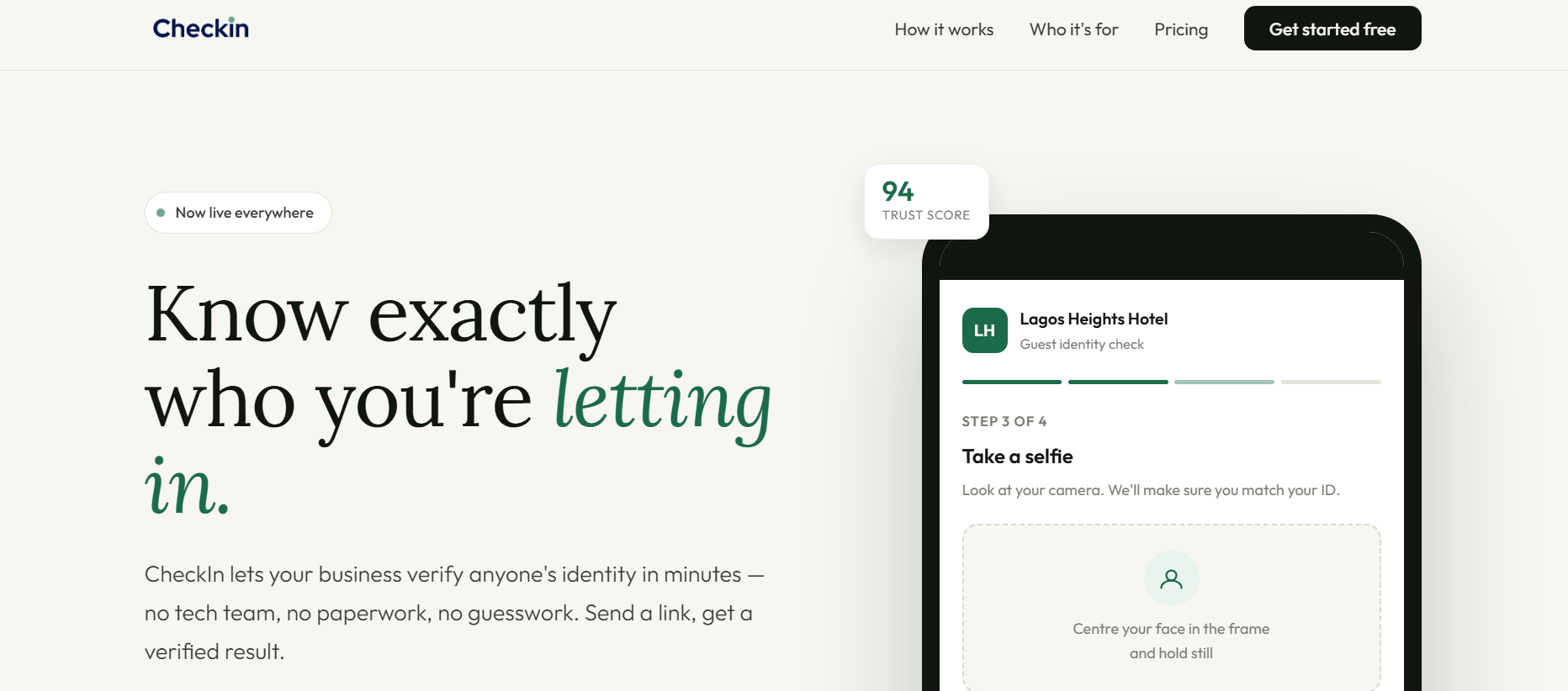
As a no-code identity verification tool built to help property managers, agents, and landlords across Africa verify tenants easily, here's how CheckIn makes it easy to verify your tenants in minutes:
- No code required: You create your verification flow from a dashboard in about two minutes, choosing the checks that matter for your property. No developer or IT team needed.
- No app download for the tenant: You share a link over WhatsApp, SMS, or email. Your tenant opens it on their own phone and completes the process right in their browser.
- Government-backed identity checks: CheckIn verifies tenants against official national identity databases across Africa, including NIN and BVN lookups in Nigeria.
- A trust score and a clear result: Every check returns a score from 0 to 100 alongside a direct Pass, Flag, or Fail decision. The result tells you exactly where your tenant stands before anything is signed.
- Works across Africa: CheckIn verifies identity in Nigeria, Kenya, Ghana, South Africa, and beyond, so the same process works whether your tenant is local or relocating from elsewhere.
With CheckIn, you get trust and protection for your property, without lifting a finger beyond sending a link.
FAQs
1. Do I need a developer to set up tenant identity verification? Tools like CheckIn by Dojah are built so you can set up and run tenant verification entirely from a dashboard, with no coding or technical team required at any point.
2. Will asking tenants to verify their identity slow down the rental process? Verification happens before the lease is signed, on the tenant's own time and device. It takes a couple of minutes and adds no real delay to a process that's already happening.
3. Is collecting a photocopy of a tenant's ID enough? A photocopy confirms a document was handed over. It does nothing to confirm the ID is genuine or that the person presenting it is actually the person named on it. Real verification checks the ID against government databases and matches it to a live selfie.
4. What if my tenant doesn't have a smartphone? The verification flow works on any phone with a browser and a camera, which covers the vast majority of smartphones in use across Africa today. No app download is required.
Start using Dojah for all your business needs


