


Go back to Blog


Jennifer Edidiong
Marketing
8 min read
Share to
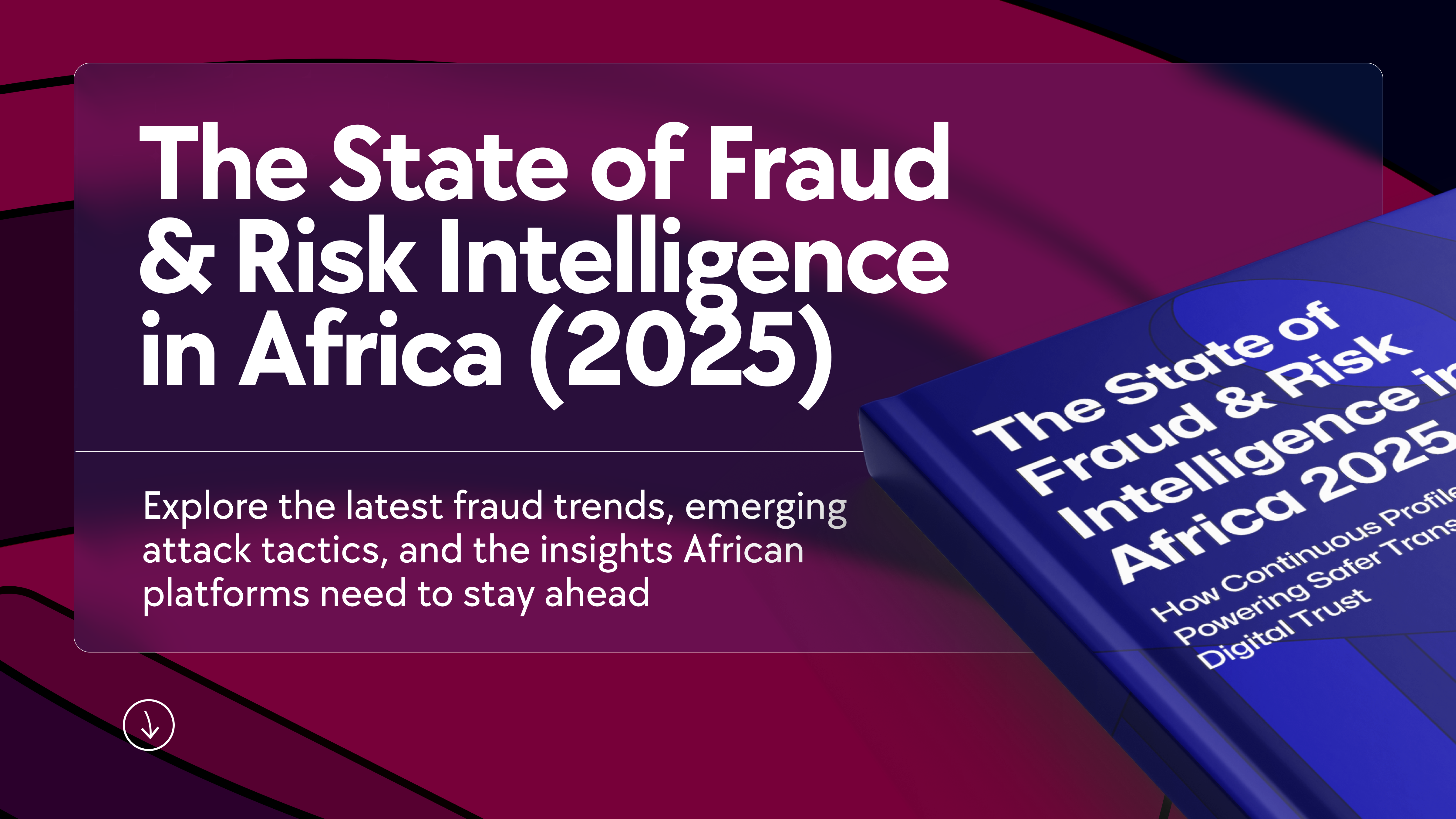
The State of Fraud & Risk Intelligence in Africa (2025)
If you run or secure a fintech, bank, or digital platform in Africa, you already know how hard staying ahead of fraud has become. Businesses across the continent lose billions in digital fraud every year, draining revenue and eroding customer trust.
Fraud teams are stretched across multiple systems tracking transactions, validating identities, and investigating alerts, often in isolation. On the other hand, fraudsters are evolving with advanced AI-powered deepfakes and synthetic identities.
The State of Fraud & Risk Intelligence Report 2025 reveals how fraud tactics are shifting and what modern risk intelligence now requires. Below are four key insights to help you reduce fraud losses, improve user trust, and scale safely across African markets.
Insight 1: Fraud in Africa Has Become More Sophisticated

Digital fraud in Africa is evolving rapidly, with the emergence of new fraud types, advanced fraud trends, and a growing financial impact across fintechs and banks. Instead of isolated scams, attackers now use AI tools, identity spoofing, and coordinated cross-platform schemes that are harder to detect.
Key Observations From The Whitepaper
- African economies lose an estimated USD 4 to 4.6 billion each year
- Fraud has grown more than 400% since 2021
- Post-onboarding fraud is rising across mobile money, banking, and fintech
- Nigeria recorded ₦52.26 billion lost in 2024
- South Africa reported over 64,000 digital banking fraud cases
- East and West Africa show fraud attempts among 28 to 43% of mobile-money users
- Deepfakes, synthetic identities, and voice cloning are increasingly used
What This Means
- Fraud is behavioural and transactional: Teams cannot rely on one-time ID checks alone; continuous monitoring across the user journey is now essential.
- Revenue and trust are at risk: Digital platforms lose both funds and customer confidence when fraud is not detected early.
- Static KYC isn’t enough: One-off verification no longer provides effective protection for your users or your revenue.
Also see: 5 Red Flags in Fraud Detection for African Fintechs
Insight 2: Static Verification Is Failing Africa’s Digital Ecosystem

One-time KYC checks may be suitable for traditional branch banking, but they fall short for digital platforms where risk evolves with every login, transaction, or interaction. Fraudsters exploit these blind spots, making static verification insufficient to protect revenue or users.
- Common methods attackers use include:
- SIM swaps and stolen credentials leading to account takeovers
- Dormant sleeper accounts reactivated months later
- Behavioural shifts once an account is compromised
- Off-peak fraud when teams are offline
- Biometric spoofing through masks, deepfakes, or altered images
- A 34% rise in biometric fraud attempts in 2024
- Impact of static KYC:
- 40–60% onboarding drop-offs due to false positives
- Reduced lifetime value from abandoned users (USD 200–500 per abandoned user)
- No insight into user behaviour after onboarding
What This Means
- Static KYC creates blind spots: As fraudsters exploit gaps between onboarding and later activity, where most attacks now occur.
- Risk evolves after onboarding: Verified users can still become compromised, and dormant accounts can unexpectedly become active.
- Layered verification is essential: Digital platforms need adaptive systems that evaluate identity, behaviour, and device signals in real time.
Download the full State of Fraud & Risk Intelligence 2025 report
Insight 3: Regional Risk Intelligence Must Reflect Africa’s Realities
Fraud isn’t the same across the continent. Attackers exploit differences in t regulatory frameworks and user behaviour, which means a one-size-fits-all approach to risk scoring is insufficient. Africa has unique fraud patterns, and you need insights tailored to each market to prevent fraud effectively.
Key Takeaways
Region | Key Threat Patterns |
| West Africa | Social engineering, insider collusion, business email compromise |
| East Africa | SIM swaps, mobile-money velocity fraud, and agent fraud |
| Southern Africa | Card fraud, AI-driven identity spoofing |
| Central Africa | Limited ID systems, weak data-sharing, and cross-border fraud |
Other Strategic Insights
- Only 30% of African states have fraud incident reporting systems.
- Only 32% support cross-border data-sharing frameworks.
- Fraudsters exploit fragmented databases to open accounts across countries.
What This Means
- Fraud patterns vary across regions: Tools must account for differences in local behaviour and regulatory conditions to remain effective.
- Cross-border collaboration strengthens defence: Sharing intelligence across markets helps detect coordinated or migrating attacks earlier.
- Regulatory awareness reduces exposure: Understanding regional rules and compliance frameworks supports safer expansion across the African market
Insight 4: Continuous Risk Intelligence Is Now Essential for African Platforms
Africa’s fraud landscape is evolving, and so must your approach. You need continuous risk scoring that evaluates identity, device, behaviour, and transactions in real time. This allows you to identify risky activity before it turns into a financial loss, while ensuring that your genuine users enjoy a seamless experience.
Key Takeaways
- Continuous assessment: Modern fraud systems continuously evaluate trust across identity, device, behaviour, and transaction signals.
- Real-time correlation: Combine IP, network, velocity, and device reputation data instantly to detect unusual patterns.
- Friction reduction for trusted users: Let genuine customers move freely while applying extra checks only to high-risk accounts.
- Proactive detection: Identify and stop fraud before it impacts your users or your bottom line.
What This Means
- Improve user experience: Continuous risk scoring reduces unnecessary blocks and false positives, allowing genuine users to transact without friction.
- Detect threats early: By monitoring activity in real time, your team can catch fraud before it escalates.
- Scale safely: Continuous risk intelligence helps you expand operations, especially in mobile-first African markets, without exposing yourself to avoidable losses.
Introducing Profiled Risk — Intelligence-Driven Trust for Africa
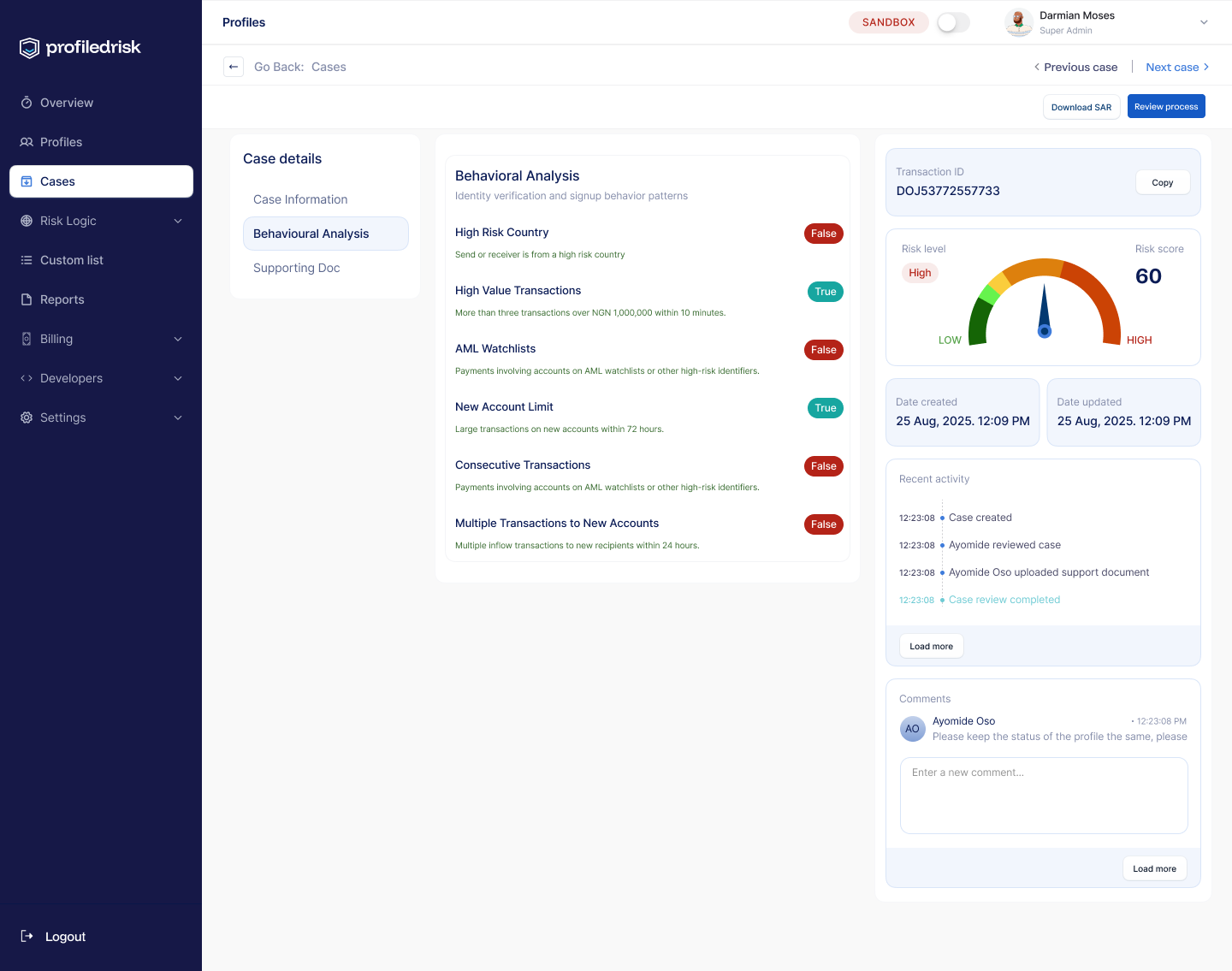
The white paper makes one point clear. Africa needs more than static KYC and disconnected fraud tools. Businesses require a unified engine that updates risk in real time and adapts to changes across identity, device, and behaviour.
Profiled Risk is built exactly for this need.
Profiled Risk is Dojah’s all-in-one fraud detection and risk scoring platform, designed for African infrastructure and regulatory realities. It helps your team see the full journey of every user, combining KYC, transaction monitoring, and behavioural insights into a single source of truth.
Core Features
- Dynamic risk scoring: Updates with every interaction, allowing you to catch risky activity early.
- Multi-signal intelligence: Correlates identity, device, network, and transaction behaviour to spot suspicious patterns across your platform.
- Hybrid AI + human review: Scales fraud investigations efficiently, letting your team focus on real threats.
- Collective defence: Shares fraud signals across your network, reducing repeat attacks and improving detection over time.
Strategic Value for African Teams
- Risk-based KYC compliance: Aligns with CBN, SARB, and other local regulations while maintaining a smooth onboarding experience.
- Stronger fraud defence: Protects your platform from deepfakes, synthetic identities, and automated attacks.
- Multiple vendor integration: Plug-and-play with all your identity and fraud providers to unify signals into one continuous risk engine.
- Faster investigations: Consolidates risk insights in one dashboard so analysts act faster with fewer tool switches.
Launching this 2025 across digital platforms, Profiled Risk takes fraud prevention to the next level, moving from “prove identity once” to “prove trust continuously.”
Stay tuned on our LinkedIn page for updates, and sign up for early access on the website.
Staying Ahead of Evolving Fraud Tactics in Africa
The State of Fraud and Risk Intelligence 2025 offers a clear view of Africa’s rapidly evolving fraud landscape. It outlines the practical steps digital platforms need to take to strengthen their defences. It brings together data, regional insights, and real attack patterns to help fraud, risk, and compliance teams make more informed decisions.
Inside the report, you will learn about:
- Advanced post onboarding attack patterns that continue to target verified users
- How AI-driven fraud techniques are spreading across African markets
- Regional risks, regulatory differences, and what they mean for your strategy
- Practical approaches to reduce fraud losses and improve user trust
- Frameworks that help digital platforms scale safely and remain compliant
If you are responsible for fraud, compliance, growth, or digital security, this is essential reading for 2025.
Download the State of Fraud and Risk Intelligence 2025 report to understand the new fraud landscape in Africa and the steps your business needs to stay ahead.
Start using Dojah for all your business needs


