


Go back to Blog


Chioma Ugwa
Marketing
9 min read
Share to
How to Build a Fraud Detection System for Fintechs in Africa
Most fintechs don't have a fraud problem. They have a system problem.
Many fintechs believe they are covered because they use multiple tools: a KYC provider for onboarding, a monitoring solution for transactions, and a separate system for risk checks. Individually, these tools work. But together, they often don't.
They operate in silos, each solving a narrow problem without contributing to a shared understanding of risk. Fraud does not respect these boundaries. It moves across them.
In African markets, this gap is even more pronounced. Fraudsters routinely reuse devices across multiple accounts, rotate SIM cards and contact details, combine legitimate and synthetic identity data, and operate in coordinated networks rather than isolated attempts. When your tools are disconnected, these patterns remain invisible.
The issue is not whether you have tools. It is whether those tools form a system.
What Most Fintech Fraud Stacks Look Like Today
Before building a better system, it helps to understand why most current setups fail.
A typical fragmented fraud stack looks like this:
- KYC at onboarding handled by one provider
- A separate transaction monitoring tool
- Manual review processes managed by a compliance team
- Risk signals that never talk to each other
This approach creates blind spots. Each tool operates independently, which means fraud that moves across stages, from onboarding to transactions to account behaviour, goes undetected because no single tool sees the full picture.
A system-driven approach looks fundamentally different:
- Identity, signals, and behaviour are connected
- Risk is continuously scored, not periodically checked
- Decisions are automated and contextual
- Monitoring feeds back into the system in real time
The difference is not just better detection. It is faster, more consistent, and more scalable decision-making. This is what separates fintechs that stay ahead of fraud from those that are always catching up.
Fraud Is a Lifecycle, Not a Checkpoint
The most important mindset shift in fraud prevention is understanding that fraud is not a moment, it is a process.
A common mistake is treating onboarding as the primary control point. Identity verification is important, but it only answers one question at one moment in time. What happens after that moment is where most risk actually emerges.
In Nigeria, fraud losses totalled ₦25.85 billion in 2025, and the primary driver of reduction was not better fraud tools, it was BVN and NIN integration applied at the infrastructure level, according to NIBSS data. That tells you something important: identity infrastructure matters, but it only solves one part of the problem.
Accounts that pass onboarding can later change devices or locations abruptly, exhibit abnormal transaction behavior, or become part of coordinated fraud activity. A system that does not continuously reassess risk will miss all of these shifts.
Effective fraud prevention follows the user from their first interaction to their last transaction. That is what a fraud detection system is built to do.
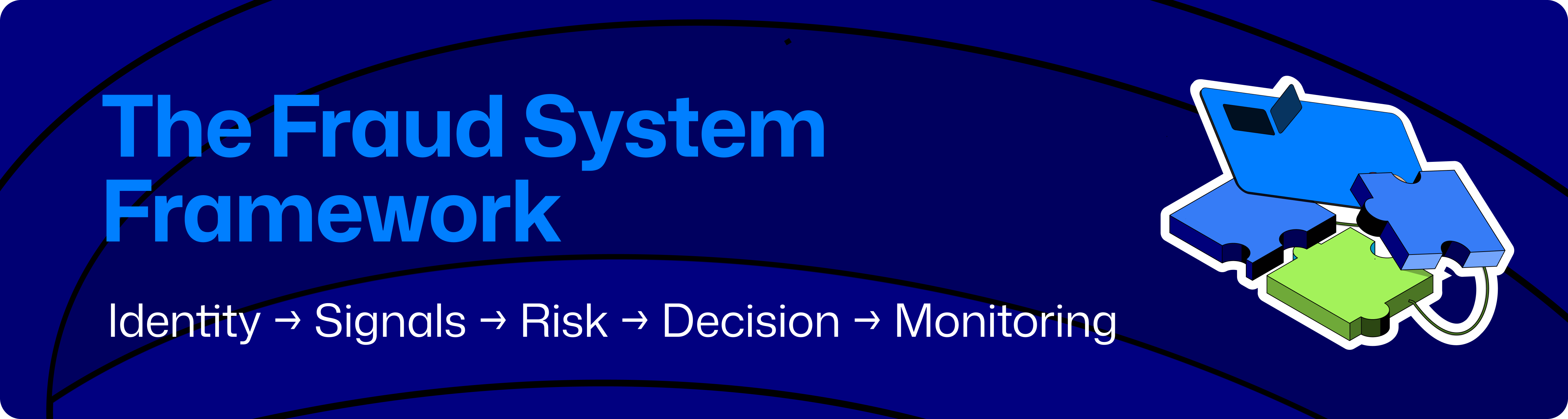
The Dojah Fraud Detection System Framework
To effectively manage fraud, fintechs need a model that reflects how risk actually evolves. At Dojah, we think about fraud detection as a connected system across the entire user lifecycle.
We call this the Fraud System Framework.
It is built on five interconnected layers: Identity, Signals, Risk Scoring, Decisioning, and Monitoring.
These layers are not steps you complete once. They form a continuous loop that evaluates risk as new data emerges. Here is how each layer works and why it matters.
Layer 1: Identity — Establishing Who the User Is
The identity layer is the entry point into your system. It includes KYC verification, document checks, and biometric validation. This layer filters out clearly invalid or fabricated identities and ensures your platform meets regulatory requirements. In Nigeria, this includes compliance with CBN AML/CFT regulations, which require fintechs to verify customer identity through government-issued IDs including NIN and BVN."
However, passing identity checks does not guarantee trustworthiness. Fraudsters can use real, compromised, or recycled identities to gain access. Identity provides a baseline, not a conclusion.
This is why identity alone is never enough; it is the foundation for everything else, not the complete defence.
For a deeper look at how fraudsters are designed to pass identity checks at signup, see: Fake Account Detection in Africa: How to Block Fraudsters at Signup.
Layer 2: Signals — Understanding How the User Operates
Once identity is established, the system must observe behavior. Signals provide this context.
The key signals your system should be collecting include device fingerprinting, IP intelligence, phone and email reputation, location consistency, and session behavior.
This is where patterns begin to emerge. Multiple accounts linked to a single device, repeated use of similar credentials, and inconsistent login patterns across geographies are all signals that an account may not be what it appears. Infrastructure that aggregates these signals helps reveal connections that isolated tools will always miss.
In African markets specifically, shared devices are common, multiple users operating from a single smartphone is normal behavior. Your signal layer needs to be calibrated to distinguish legitimate shared usage from coordinated fraud activity.
Layer 3: Risk Scoring — Making Sense of Complexity
Signals by themselves are noisy. A single suspicious signal might mean nothing. The system needs a way to interpret the combination.
The risk scoring layer consolidates all available inputs and evaluates them using predefined rules, behavioural patterns, and machine learning models. The output is not a binary decision but a spectrum of risk, low, medium, high, that reflects the full picture of what is known about an account at any given moment.
This allows fintechs to move from rigid checks to adaptive decision-making. A ₦500,000 transfer to a new beneficiary carries different risk than routine airtime top-ups from the same account. Risk scoring makes that distinction automatically and in real time.
Layer 4: Decisioning — Responding in Real Time
Once risk is quantified, the system must act. The decision layer determines what happens next based on the risk score.
Low-risk users proceed without friction. Medium-risk users are routed to additional verification, an OTP, a liveness check, or a step-up authentication. High-risk users are blocked or escalated to your risk team for manual review.
The objective is to align the response precisely with the risk level. Systems that are too aggressive create unnecessary friction and hurt conversion. Systems that are too lenient expose the platform to losses. A well-calibrated decision layer maintains this balance continuously, not just at onboarding.
Layer 5: Monitoring — Tracking Risk Over Time
This is the layer most fraud systems underinvest in and the one that matters most.
Fraud is rarely a single action. It unfolds over time. A mule account might pass every check at signup but only activate weeks later. A compromised account might behave normally for months before an attacker drains it. An organized fraud ring might spread activity across dozens of accounts to avoid triggering individual thresholds.
Monitoring catches all of this by continuously tracking transaction patterns, device changes, behavioral anomalies, and relationships between accounts. It is how platforms detect account takeover attempts before funds move, identify money movement networks before they scale, and spot evolving fraud strategies before they cause significant losses.
Without this layer, your fraud detection stops exactly where it should begin.
For a detailed breakdown of how transaction monitoring works in practice, see: Transaction Monitoring for Fintechs: Processes, Tools and Challenges.
How the System Works as a Whole
Each of the five layers connects to form a continuous loop:
Identity → Signals → Risk Scoring → Decisioning → Monitoring
Every user interaction feeds new data into the system. Every decision is made with more context than the last. Over time, the system becomes more accurate, more adaptive, and harder for fraudsters to game.
This is what moves fintechs from reacting to fraud after it happens to identifying risk as it develops which is the only position from which you can actually stay ahead.
Scaling a Fraud System in African Fintech Environments
As your fintech grows, the fraud landscape grows with it. Higher transaction volumes, broader user bases, and expansion into new markets all create new attack surfaces.
Scaling effectively requires continuous refinement of rules and models as fraud patterns evolve, expansion of signal coverage as new channels and products are introduced, tighter integration between system components as your stack grows, and ongoing evaluation of detection outcomes to reduce false positives without losing coverage.
Fraud prevention is not static infrastructure. It is an adaptive system that must grow alongside your platform.

How Dojah Enables This System
Building this level of integration internally is complex, expensive, and time-consuming. Most fintechs do not have the engineering resources or the data infrastructure to do it from scratch.
Dojah provides infrastructure that connects all five layers in a single platform — identity verification through KYC and document checks, signal aggregation across devices, contact data, and behavior, risk scoring powered by AI models, real-time decisioning workflows, and continuous monitoring across the full user lifecycle.
This allows fintechs to move away from fragmented tooling and toward a unified approach to risk without building it themselves.
Most fintechs discover their system gaps after a fraud incident, not before.
Book a Fraud Risk Strategy Session to identify where your gaps are and how to close them
FAQs
What is a fraud detection system for fintechs? A fraud detection system is a connected set of tools and processes that evaluates risk across the entire user lifecycle from onboarding through transactions and ongoing account activity. It goes beyond one-time identity checks to continuously assess behavior, signals, and patterns.
What are the five layers of an effective fraud detection system? The five layers are Identity, Signals, Risk Scoring, Decisioning, and Monitoring. Each layer builds on the previous one and feeds data back into the system, creating a continuous loop that improves detection over time.
Why do disconnected fraud tools fail African fintechs? Disconnected tools each solve a narrow problem without sharing data. Fraudsters in African markets routinely reuse devices, rotate SIM cards, and operate in coordinated networks — patterns that only become visible when your tools work together as a system.
What is the difference between fraud detection and fraud monitoring? Fraud detection typically refers to catching fraud at the point of onboarding or transaction. Fraud monitoring is the continuous tracking of user behavior, device activity, and account patterns over time. Both are necessary, monitoring is where most platforms underinvest.
How does Dojah help fintechs build a fraud detection system? Dojah provides infrastructure across all five layers — identity verification, signal aggregation, AI-powered risk scoring, real-time decisioning, and continuous monitoring, through a single integrated platform. This allows fintechs to replace fragmented tooling with a unified approach to risk.
How do I know if my current fraud stack has gaps? Common signs include fraud occurring after successful onboarding, high false positive rates blocking legitimate users, manual review backlogs, and no visibility into post-transaction behavior. A fraud risk strategy session with Dojah can help you identify exactly where your gaps are.
Start using Dojah for all your business needs


